Buying Process
Unmarried Couple Buying Property in Spain With a Mortgage: Shares vs Liability
In brief
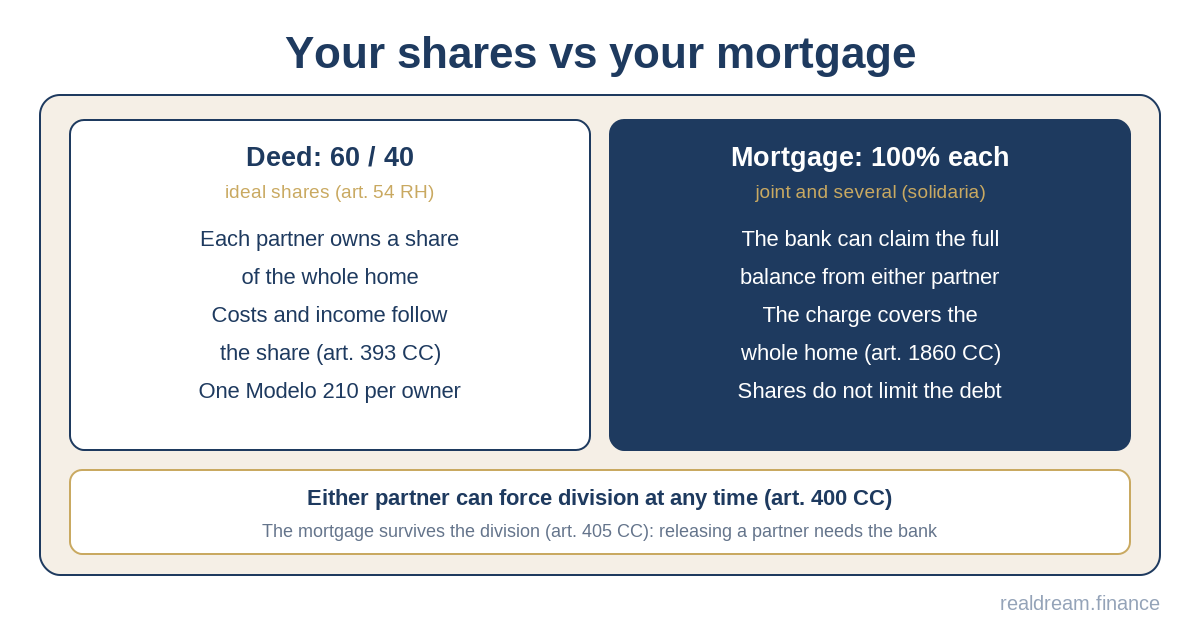
Unmarried couples in Spain buy as co-owners pro indiviso, with each partner's ideal share written in the deed (article 54 of the Mortgage Regulation). Those shares do not limit what you owe the bank: Spanish mortgage deeds normally make both borrowers jointly and severally liable for 100%. Either partner can force division at any time, but the mortgage survives it, and the surviving partner inherits nothing without a will.
Most guides to buying in Spain as an unmarried couple stop at three points: you will own the property pro indiviso, Spain has no “joint tenancy with right of survivorship”, and you should sign a private agreement. All three are true. What they rarely explain is how the shares written in the deed interact with the mortgage — and that is where couples get surprised, because the deed and the loan follow two different sets of rules.
Shares in the deed: how co-ownership works in Spain
Two partners who buy together hold the property in comunidad de bienes, the Spanish form of co-ownership. Article 392 of the Spanish Civil Code (Código Civil) defines it as property belonging pro indiviso to several people: each partner owns an ideal share of the whole home, not a specific room or floor.
The share has to be written down. Article 54 of the Mortgage Regulation (Reglamento Hipotecario) requires the Land Registry entry to state each co-owner’s ideal portion with exact mathematical data — 50/50, 60/40, one third and two thirds. A share expressed only as “the euros each of us paid” does not satisfy the rule. If a document leaves the point open, article 393 of the Civil Code presumes the shares are equal unless proven otherwise.
The share decides three things:
- benefits and costs: under article 393, each partner contributes to expenses and receives income in proportion to their share;
- tax: each non-resident co-owner files their own Spanish non-resident return (Modelo 210) on their share of the deemed or actual rental income;
- what each partner can leave or sell: each partner can dispose of their own share, but not of the whole property.
What the share does not decide is how much each partner owes the bank.
The mortgage ignores your shares
A 60/40 deed does not mean you owe the bank 60% and 40%. Two rules explain why.
Joint and several liability. Article 1137 of the Civil Code says that when several people share one debt, each one is liable for the whole amount only if the obligation expressly says so, as a solidaria obligation. Without that clause, article 1138 presumes the debt is divided into equal parts. Spanish mortgage deeds normally include the clause: the borrowers sign as deudores solidarios, and the bank can claim the entire outstanding balance from either partner. Check the wording in the FEIN (the European standardised information sheet the bank must give you before signing) and in the draft deed.
The charge is indivisible. Article 1860 of the Civil Code states that a mortgage is indivisible. The mortgage burdens the whole property, not 60% of it, and a partial repayment does not free any part of the home until the debt is paid in full.
| Property deed | Mortgage loan | |
|---|---|---|
| What it records | ownership, by ideal share | debt to the bank |
| Rule | art. 54 Reglamento Hipotecario, art. 393 Código Civil | arts. 1137, 1138 and 1860 Código Civil |
| Typical split | 50/50 or proportional to contributions | each borrower liable for 100% (solidaria) |
| Can one partner leave it alone? | yes, by selling or dividing the share | no, only with the bank’s agreement |
If you split up: division does not touch the mortgage
Under Spanish law, nobody can be forced to stay a co-owner. Article 400 of the Civil Code allows each partner to ask for the property to be divided at any time. The only limit is a written pacto de indivisión, an agreement to keep the property undivided for a fixed period of no more than ten years, renewable by a new agreement.
A home cannot be physically split, so in practice division means one partner buys the other out, or the property is sold — by agreement or through the courts with an acción de división.
The mortgage survives all of this. Article 405 of the Civil Code says division does not prejudice third parties, who keep their mortgage and other real rights. Three consequences follow:
- A buyout does not release the leaving partner. The partner who leaves remains a joint debtor until the bank agrees to remove them, usually by a novation of the loan after checking that the remaining partner can carry it alone. The bank is not obliged to agree.
- A sale has to clear the whole balance. The buyer will not accept the property with your mortgage on it, so the sale price first repays the bank in full.
- Unequal repayments create a claim, not a new share. If one partner pays the instalments alone after the split, the deed does not change; that partner has a claim against the other, which is easier to prove if it is in writing.
A co-ownership agreement signed before completion — who pays what, what happens if one stops paying, how a buyout price is fixed — is the tool the guides recommend, and the reason is article 400: without it, the default is that either of you can force a sale.
If one of you dies
The surviving partner does not inherit automatically. In Spain there is no right of survivorship, so the deceased partner’s share passes through their estate. Under the Spanish Civil Code, if there is no will, article 913 calls the deceased’s relatives, a widow or widower and the State. An unmarried partner is not on that list. Some autonomous communities give rights to registered partners (parejas de hecho), and which law governs the estate of a foreign owner depends on the case, so a will is the only way to be sure of the outcome.
The debt does not disappear either. As the Banco de España explains in its guidance on the death of a mortgage holder, the loan becomes part of the deceased’s estate, and the heirs who accept it take on the debt. Meanwhile the surviving partner, as a joint and several borrower, can still be asked for the full instalment.
Inheritance tax adds a final layer. Under the state rules of the Spanish Inheritance and Gift Tax Act (Ley 29/1987, article 20), heirs with no family relationship to the deceased — Group IV — receive no reduction. Several regions treat registered partners like spouses, but the result depends on the region and the residence of the parties — see which region’s inheritance tax rules apply to a non-resident. A life insurance policy linked to the mortgage can cover the outstanding balance; it is a separate decision from the will.
Unequal contributions: the gift question
Couples often put in different amounts — one sells a home in the UK, the other has a smaller deposit — and still register 50/50. Article 3.1.b of Ley 29/1987 taxes acquisitions of assets by gift or any other free transfer between living persons. If the deed gives a partner more than they paid for, the difference can be read as a gift from the other partner, and between unmarried partners Group IV rules apply.
The cleaner options are:
- match the shares to the money, for example 65/35;
- register 50/50 and document the difference as a loan between partners, with repayment terms;
- take advice before signing if the deposit comes from family money or from the sale of a property abroad.
Whatever you choose, the source of each partner’s money will also be checked under anti-money-laundering rules, so keep the transfer trail for both deposits. If you are still deciding how to split shares and loan, a non-resident mortgage pre-assessment shows how a Spanish bank will read your two incomes and who it will require on the deed.
A pre-signing checklist for unmarried couples
- Decide the shares in writing before the contrato de arras, and align them with contributions.
- Read the liability clause in the FEIN: assume each of you is liable for 100% of the loan.
- Sign a co-ownership agreement covering payments, exit, buyout price and an optional pacto de indivisión (maximum ten years).
- Make Spanish wills, each in favour of the other if that is what you want, and check the inheritance tax treatment in the region where the property is.
- Consider registering as a pareja de hecho where you live, and check whether that region gives registered partners rights or tax treatment equivalent to spouses.
- Plan the tax filings: two non-resident owners means two Modelo 210 returns, each on its own share.
None of these steps is expensive at the start. All of them become expensive after a separation or a death, when the deed, the loan and the law each point in a different direction.
Sources
- BOE — Código Civil, arts. 392, 393, 400, 405, 913, 1137, 1138 and 1860
- BOE — Reglamento Hipotecario, art. 54 (ideal share of each co-owner)
- BOE — Ley 29/1987, del Impuesto sobre Sucesiones y Donaciones, arts. 3 and 20
- Banco de España, Portal del Cliente Bancario — What happens when the holder of a mortgage loan dies?
- European e-Justice Portal — Property consequences of registered partnerships: Spain
Frequently asked questions
Can an unmarried couple get a joint mortgage in Spain?
Yes. Spanish law does not require borrowers to be married. Both partners usually sign as borrowers so the bank can count both incomes, and the deed normally makes them jointly and severally liable, which means the bank can claim the whole debt from either of them, whatever their ownership shares.
If we own the property 60/40, do we owe the bank 60/40?
Usually not. The shares in the deed follow article 54 of the Mortgage Regulation and only describe ownership. The loan follows the Civil Code: a joint and several (solidaria) clause, standard in Spanish mortgage deeds, makes each borrower liable for 100%. Check the liability clause in the FEIN and the draft deed.
What happens to the house and the mortgage if we split up?
Either partner can ask for division at any time under article 400 of the Civil Code, unless you signed a pact to keep it undivided for up to ten years. Division means a buyout or a sale. The mortgage survives (article 405), and the leaving partner stays liable until the bank agrees to release them.
Does my partner inherit my share if I die without a will?
Not under the Spanish Civil Code: article 913 calls relatives, a widow or widower and the State, not an unmarried partner. Some regions grant rights to registered partners, and the law governing a foreigner's estate depends on the case. A will in favour of your partner is the reliable route.
Is it a problem if we register 50/50 but paid different amounts?
It can be. If one partner receives a larger share than they paid for, the difference may be treated as a gift under article 3 of the Inheritance and Gift Tax Act, and unmarried partners fall in Group IV under the state rules. Matching shares to contributions, or documenting the difference as a loan, avoids the question.
Do both of us have to file Spanish tax returns?
Yes, if you are both non-residents. Each co-owner files their own Modelo 210 non-resident return on their share of the deemed or actual rental income from the property, so two owners means two returns. The share recorded in the deed sets the proportion each of you declares.
Roberta
Credit intermediary registered with the Banco de España (ICI)
Want us to take care of it?
Our non-resident mortgage pre-assessment shows how a Spanish bank will treat your two incomes and who it will require on the deed, before you sign the arras.