
Buying Process
The Mortgage Clause in a Contrato de Arras: How to Set a Deadline That Works
In brief
A financing clause lets you recover your arras deposit if the bank refuses your mortgage — but only if its deadline is realistic. Spanish law fixes two hard points to count backward from: the FEIN must reach you at least 10 natural days before signing (14 in Catalonia), and the notary checks this before authorising the deed. Everything else — underwriting, apostilles, sworn translations — has to fit before that point, not after it.
A financing clause in a contrato de arras only does its job if its deadline is real. Spanish law fixes two hard points in the mortgage-signing calendar — not the whole process, just the last stretch of it — and a working deadline has to be counted backward from those, not forward from the day you sign the arras. This matters more for a non-resident buyer, because the phase that eats the most time — apostilles, sworn translations, a file that proves foreign income to a Spanish underwriter — sits entirely before that legal clock even starts, and nothing in the law protects those days.
What the financing clause actually changes
Under article 1454 of the Código Civil, arras (a deposit paid to secure a purchase) work by default like this: if the buyer walks away, they lose the deposit; if the seller walks away, they return it doubled. That’s the whole mechanism — no judge weighs fault, no damages are calculated, the money simply moves.
A financing clause exists to carve out one specific case from that default: the bank refuses the mortgage. Without it, a denied loan and a change of mind look identical to the contract — the buyer loses the deposit either way. With it, a documented refusal inside the agreed deadline lets the buyer walk away and get the money back in full.
One detail buyers skip past: this “penitential” version of arras — the one where either side can simply withdraw — isn’t automatic. Case law is consistent that the contract has to expressly reference article 1454, or explicitly state the right to withdraw; a deposit called “arras” with no such wording can be read as a plain advance payment instead, which changes what happens on breach. The financing clause and this express reference are two separate things that both have to be in the text.
Why “60 days” is a guess, not a plan
Market habit puts a round number of days in the arras — 30, 60, sometimes 90 — because that’s what the last contract used, not because anyone counted anything. For a non-resident buyer that habit is risky in a specific way: the number gets picked before the file is even open, so it can’t reflect how long this buyer’s documents will actually take to assemble.
There’s a second, narrower reason to avoid one particular number: don’t put an estimate of how long the whole mortgage will take to arrange into the clause or the conversation with the agent. Spanish banks don’t commit to a total processing time, and neither does the law — the only fixed points are the ones below. A clause built around an assumed total duration is a clause built on a claim nobody actually made.
The two dates the law actually fixes
Two moments in the mortgage-signing process have a real, enforceable minimum — everything else is bank-internal timing that varies file by file.
1. The FEIN has to reach you at least 10 natural days before signing. The FEIN (Ficha Europea de Información Normalizada) is the bank’s binding mortgage offer. Under article 14.1.a of Ley 5/2019 (the mortgage credit law, LCCI), once delivered it is binding on the lender “durante el plazo pactado hasta la firma del contrato que, como mínimo, deberá de ser de diez días” — for at least ten days, and the lender cannot change a single term of it during that window.
2. The notary checks this before authorising the deed. Under article 15.2, the notary verifies that the 10-day delivery actually happened — via the acta notarial de transparencia, a prior deed recording that the borrower received the FEIN in time and had the chance to ask questions free of charge. Skip this step and the loan deed doesn’t get signed, full stop: it isn’t a formality the notary can wave through.
Catalonia extends this to 14 natural days. Under article 262-4.1 of the Codi de consum de Catalunya (Llei 22/2010, as amended by Llei 20/2014), lenders operating in Catalonia must deliver precontractual information at least fourteen days before signing — four more than the national minimum. This isn’t a theoretical distinction: in 2021 a land registrar in Manresa suspended the registration of a mortgage deed specifically because the lender hadn’t proven compliance with this Catalan 14-day duty, and the Dirección General de Seguridad Jurídica y Fe Pública upheld the suspension on appeal. The deed had already been signed before a notary; it still couldn’t be registered.
⚠️ Some professional sources also describe an extended period in other regions — the Balearic Islands are mentioned most often. We couldn’t verify that against the region’s own legal text before publishing this, so treat any number beyond the Catalan one as unconfirmed until your notary or lawyer checks it for the specific region where you’re buying.
Counting backwards from signing day
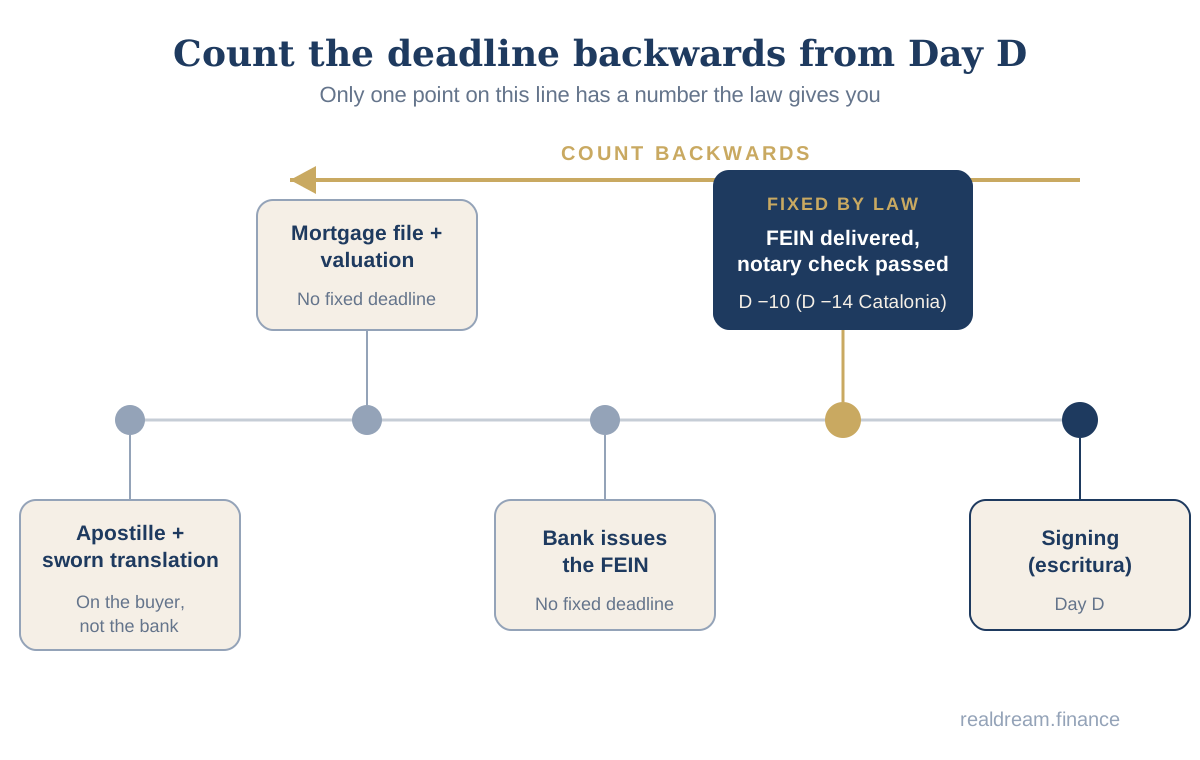
Once you have a real signing date — call it day D — the deadline in the arras isn’t D plus a guess. It’s built by walking backward through the points that are actually fixed, plus the ones that aren’t but still take real time:
| Stage | When it has to happen | Fixed by law? |
|---|---|---|
| Signing (escritura) | Day D | — |
| FEIN delivered, notary check passed | D − 10 (D − 14 in Catalonia) | Yes — Ley 5/2019 art. 14.1.a / 15.2 |
| Bank issues the FEIN | Before D − 10, no fixed number of days | No — internal underwriting |
| Valuation (tasación) completed | Before the FEIN, no fixed number of days | No — ordered by the bank, done by an independent appraiser |
| Full mortgage file submitted | Before the valuation | No |
| Non-resident documents ready (apostilled, sworn-translated) | Before the file is even complete | No — entirely on the buyer |
Only the second row has a number the law gives you. Everything below it is real time that has to happen, but no institution — bank or public administration — guarantees how long it takes. That’s precisely why it belongs on the buyer’s side of the calculation, not in a promise from anyone else: ask the bank in writing when they expect to issue the FEIN once the file is complete, and treat that answer as a working estimate, not a deadline.
Where non-residents lose the days that matter
The bottom two rows of that table are where a badly-set arras deadline usually gets consumed, and they never appear in a generic version of this clause because they’re specific to buying from abroad.
An apostille — the certification under the 1961 Hague Convention that makes a foreign public document valid in Spain — is issued by an authority in the buyer’s own country: a court, a foreign ministry, or an equivalent body depending on the document and the country. A sworn translation, where the receiving bank or notary requires one, has to come from a traductor jurado accredited by Spain’s Ministerio de Asuntos Exteriores, or be certified in a form the specific office accepts.
Neither step has a legal deadline attached. Both depend on institutions outside the mortgage process — a court registry, a foreign ministry, a translator’s schedule — that the Spanish bank has no relationship with and no way to expedite. A file that’s missing one certified document doesn’t move to underwriting; it waits. This is the phase a deadline copied from a resident buyer’s arras never accounts for, because a resident buyer doesn’t have it.
Writing the clause: what has to be in it
Four things, specifically, or the clause protects less than it looks like it does:
- A calendar date, not a duration. “60 days from signing” moves every time signing gets delayed for an unrelated reason. A fixed date — set using the table above — doesn’t.
- The event that activates it is a written refusal, not silence. If the clause triggers on “the bank doesn’t approve the loan,” a bank that simply never answers by the deadline leaves the buyer in a gap: no refusal to point to, no approval either. The clause should trigger on an explicit written denial, or on the deadline passing without a FEIN having been delivered — whichever the buyer’s lawyer drafts it around, but it has to name one of the two.
- A notification method that can be proven. Spanish practice for this is a burofax (or another channel that produces a dated, provable record) sent to the seller, not a phone call or a message with no timestamp attached. If the clause is never triggered in writing before the deadline, the default arras rule — lose the deposit — can apply regardless of what actually happened with the bank.
- An extension mechanism tied to a fact, not an open door. Notary slots run out, especially close to a deadline in a busy area. A clause that allows a short, defined extension when the notary confirms no earlier date is available protects the buyer against a scheduling problem that has nothing to do with the mortgage itself — without turning the deadline into something either side can stretch indefinitely.
If the bank goes quiet instead of saying no
The gap the second point above is built for is the most common failure in practice: the deadline is close, there’s no FEIN, and no formal refusal either — the file is just sitting somewhere in underwriting. At that point, a written request for the file’s status, sent to the bank and copied to whoever is coordinating the purchase, creates the paper trail the clause needs regardless of which way the bank eventually answers. Waiting for the phone to ring is the one option that leaves the buyer with nothing to show if the deadline passes.
If you want someone to check the legal, planning and debt status of the property on the same timeline as your arras, our due diligence report is delivered in 3 working days by a lawyer qualified in Spain.
Sources
Frequently asked questions
What happens to my arras deposit if the bank refuses the mortgage?
If the arras contract has an express financing clause, a documented refusal within the agreed deadline lets you cancel and recover the full deposit. Without that clause, a mortgage refusal is treated the same as any other change of mind: under article 1454 of the Código Civil you lose the deposit.
How many days before signing does the bank have to give me the FEIN?
At least 10 natural days everywhere in Spain, and 14 in Catalonia, under article 14.1.a of Ley 5/2019 and article 262-4.1 of the Codi de consum de Catalunya. The notary checks this happened before authorising the deed.
Can the bank change the mortgage terms after giving me the FEIN?
No. Once delivered, the FEIN is a binding offer for the lender for at least the statutory period — the terms in it cannot change before signing.
Does silence from the bank count as a refusal for the financing clause?
Only if the clause says so. Draft it so that either a written refusal or the deadline passing without a FEIN having been delivered triggers the right to cancel — otherwise silence can leave you with no formal refusal to point to.
Why does a non-resident need more time than the arras deadline usually assumes?
Because apostilling foreign documents and getting sworn translations, where required, happens before the mortgage file is even complete — and neither step has a legal deadline, unlike the 10/14-day FEIN period that follows it.
Is "arras" always the version where I only lose the deposit?
No. That "penitential" version requires the contract to expressly reference article 1454 of the Código Civil or state the right to withdraw. Without that wording, the deposit can be treated as a plain advance payment instead, with different consequences on breach.
Roberta
Credit intermediary registered with the Banco de España (ICI)
Want us to take care of it?
We check the legal, planning and debt status of the property in 3 working days — on the same timeline your arras deadline has to respect.