Buying Process
Late Off-Plan Completion in Spain: Your Right to Cancel and Refund
In brief
A late off-plan home in Spain gives you a statutory choice. Under the first additional provision of the LOE, if the home was not delivered you may rescind the contract and recover the sums paid on account, taxes included, plus legal interest, or grant the developer a written extension. A bank guarantee or caution insurance policy backs the refund. Whether your delay justifies rescission depends on your contract and facts, so a Spanish lawyer should read it before any formal notice.
An off-plan contract in Spain has you pay in instalments while the building is still going up, so a late completion leaves a large share of your money with the developer. Many guides on this question still rely on Ley 57/1968, which Ley 20/2015 repealed when it rewrote the first additional provision of the Ley de Ordenación de la Edificación (LOE). This guide follows the current text: what it lets you do when a home is not delivered, who pays, which deadlines the law itself sets, and what a Spanish lawyer should read before any formal notice goes out.
Which law covers a late off-plan completion in Spain?
The first additional provision of the LOE (Ley 38/1999), in the wording given by Ley 20/2015, which has applied since 1 January 2016. It covers anyone who promotes the construction of homes of any kind and wants buyers to hand over money during construction. Ley 57/1968, which used to regulate the same subject, is expressly repealed by the third repealing provision of the LOE, added by Ley 20/2015.
Two limits matter in practice. A contract signed before 2016 may fall under the earlier regime. And the third transitional provision of the LOE gave insurers until 1 July 2016 to adapt existing policies for amounts paid from that date. Which regime governs an older contract is a question for a lawyer, not for a general guide.
What can you do when the home is not delivered?
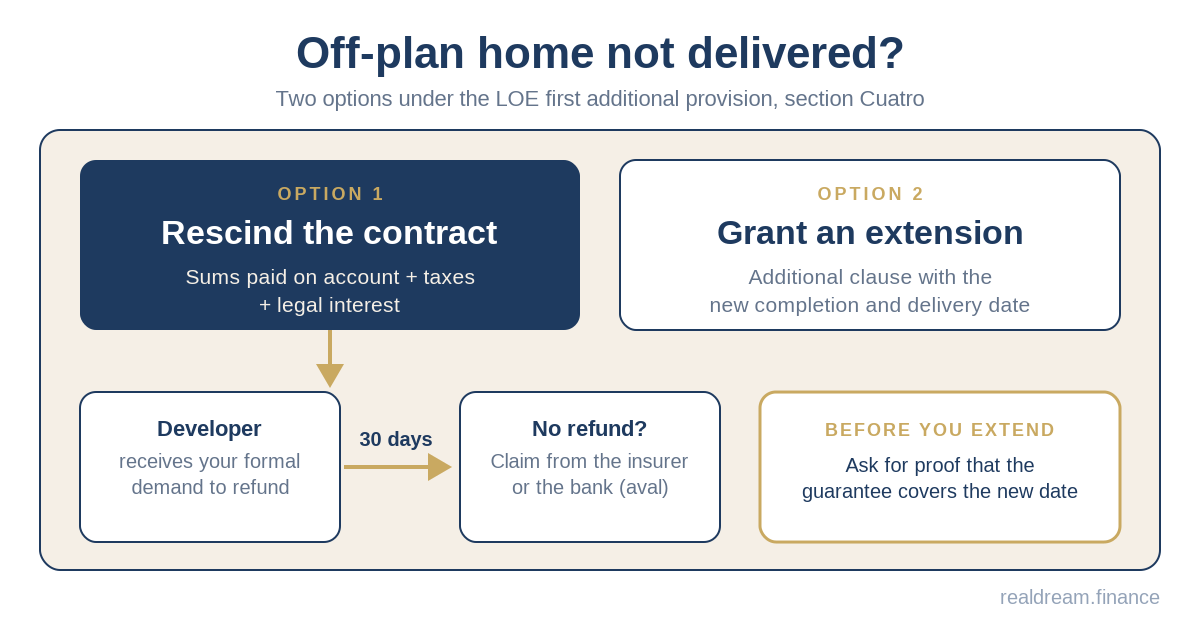
You choose between two options. Section Cuatro of the provision says that if construction never started or the home was not delivered, you may rescind the contract and recover the sums paid on account, applicable taxes included, plus legal interest, or you may grant the developer an extension. The extension must be recorded as an additional clause stating the new completion date and the new delivery date.
| Option | What the provision says | What to check |
|---|---|---|
| Rescind | Refund of the sums paid on account, taxes included, plus legal interest (section Cuatro) | The delivery date in your contract, and whether the home meets the delivery test below |
| Extend | Additional clause with the new completion and delivery date (section Cuatro) | That the guarantee also runs to the new date |
The statute ties the right to the deadlines in your contract. Section Uno.1.a refers to a building that does not start or does not reach completion “in the agreed period”, and section Tres.a requires the contract to state the developer’s duty to refund if the work is not started or finished within the contractual deadlines. A grace period written into your contract therefore matters. Whether a given grace clause holds up against a consumer is for your lawyer to judge.
The Civil Code adds a general rule. Article 1124 lets a party to a two-sided contract resolve it when the other side fails to perform, and says the court decrees the resolution unless there are justified grounds to set a term.
What counts as delivery: keys, or keys plus licence?
Delivery under the provision is tied to the licence, not to the keys alone. Section Tres.a requires the contract to state that the developer refunds the sums paid if the cédula de habitabilidad, the licence of first occupation (LPO) or an equivalent document authorising occupation is not obtained. Section Cinco cancels the guarantee only after that document is issued and the developer proves delivery of the home to you.
The Supreme Court has applied the same idea without a clause. A judgment of 11 March 2013, reported by the judiciary’s press office, held that the lack of a first-occupation licence is an essential breach of the seller’s delivery obligation even when the contract says nothing about it, if the licence cannot be foreseen within a reasonable time. The developer argued that it had obtained a licence through administrative silence and later obtained a second one. The chamber rejected both: rights contrary to planning law cannot be acquired by silence, and the later licence was incomplete because it left out the communal pools.
What has the Supreme Court said about delay itself?
A delay can justify rescission, but timing matters. The Civil Chamber held in a judgment reported on 20 February 2015 that late delivery of a home under construction justifies rescission at the buyer’s request, provided the buyer exercised that right before the seller required them to sign the public deed. Courts assess each delay on its facts, so the contract date, any grace period and the cause of the delay all count.
| Ruling (as reported by the judiciary’s press office) | Facts | Holding |
|---|---|---|
| Civil Chamber, reported 20 February 2015 | Contract signed in 2007, delivery due September 2009, works stopped for a year because of soil defects. The buyers refused a new date and asked to terminate one month after the agreed date. | Delay in delivering a home under construction justifies rescission, if exercised before the seller requires the deed to be signed |
| Civil Chamber, 11 March 2013 | Home bought in January 2004, building finished at the end of 2005, planning licence under challenge | Missing first-occupation licence is an essential breach even without a clause, when it cannot be foreseen within a reasonable time |
Both contracts predate 2016, and both rulings are known here through the press office’s summaries, not the full judgments. Your lawyer should read the full texts and check whether they fit your facts.
Who pays the refund: the developer, then the guarantor
The developer owes the refund first. Section Uno.1 requires every developer who collects advances to guarantee their return, from the grant of the building licence, through a caution insurance policy with an authorised insurer or a joint-and-several bank guarantee (aval). The advances must also pass through a bank into a special account kept apart from the developer’s other funds. The guarantee covers the sums you paid, taxes included, plus the legal interest of money.
If you formally demand the refund and the developer does not pay within 30 days, you can claim from the insurer or the bank. You can also claim directly when a prior demand on the developer is impossible. The insurer must pay within 30 days of your claim.
| Caution insurance (seguro de caución) | Bank guarantee (aval) | |
|---|---|---|
| Set-up | One individual policy per buyer, identifying the property (section Dos.1.a) | Issued and kept in force by a credit institution (section Dos.2.a) |
| Amount covered | All advances in the contract, taxes included, plus legal interest from the actual payment to the planned delivery date (section Dos.1.b) | The same total and the same interest period (section Dos.2.a) |
| Claim route | Formal demand on the developer, then 30 days without refund (section Dos.1.h) | Same route (section Dos.2.b) |
| Developer’s premium | The insurer cannot use the developer’s unpaid premium against you (section Dos.1.e) | Not applicable |
| Time limit in the provision | None equivalent to the two-year lapse; check your policy conditions | Lapses two years after the developer’s breach if you have not demanded rescission and refund (section Dos.2.c) |
Interest deserves a precise reading. The insured sum counts legal interest from the day each instalment was paid until the planned delivery date. Section Cuatro, which governs the refund itself, says “legal interest” without stating a start date. Guides written under Ley 57/1968 quote a fixed 6% annual rate; the current text refers to the legal interest of money instead.
Which deadlines does the law set?
The provision sets two 30-day periods and one two-year lapse. The table collects them, with the general limitation period for personal actions from the Civil Code.
| Deadline | Period | Source |
|---|---|---|
| Developer’s response to a formal demand before you can claim from the guarantor | 30 days | Sections Dos.1.h and Dos.2.b |
| Insurer’s payment after your claim | 30 days | Section Dos.1.h |
| Bank guarantee lapses if you have not demanded rescission and refund | 2 years from the developer’s breach | Section Dos.2.c |
| Personal actions with no special period | 5 years from when performance can be demanded | Civil Code, article 1964.2 |
The Civil Code period applies to actions without a special period. Which period governs a claim against the developer or a guarantor, and whether regional civil law changes it, is for your lawyer to say. How an extension affects these periods is another question to settle before you sign one.
What to gather before a formal notice
Gather the documents below first. They show whether the provision applies and which guarantor to address.
| Document | What to look for |
|---|---|
| Purchase contract | Delivery date, any grace period, the refund clause required by section Tres.a |
| Guarantee certificate | The name of the insurer or bank (section Tres.b) and the document proving the guarantee, which the developer must hand over when the purchase contract is signed |
| Payment receipts | The special account designated in the contract (section Tres.c) and every amount paid, taxes included |
| Licence status | Whether the town hall has issued the cédula or LPO, which decides the delivery test |
| Any extension | An additional clause under section Cuatro, and proof that the policy or bank guarantee covers the new date |
On extensions, section Dos.1.f says the developer “may” extend the insurance policy by paying the premium and must inform you. The text does not say the policy extends itself, so ask for written proof before you sign.
The 30-day periods run from a formal demand, in Spanish a requerimiento fehaciente: a demand made in a way that proves its content and the date it reached the developer, such as a burofax. The wording decides whether you rescind or extend, and the two-year lapse rule for a bank guarantee turns on whether you demanded rescission. Have a Spanish lawyer read the contract, the guarantee and the dates before the burofax goes out. This guide explains the statute and cannot assess your case.
If you are still at the draft-contract stage, a property due diligence check covers the legal, planning and debt status of the property before you pay a first instalment.
Sources
- BOE: Ley 38/1999, de Ordenación de la Edificación (first additional provision, third repealing provision; consolidated text)
- BOE: Ley 20/2015, de ordenación, supervisión y solvencia de entidades aseguradoras (final provision three, amending the LOE)
- BOE: Código Civil (articles 1124 and 1964)
- Poder Judicial: Supreme Court press note, 20 February 2015 (late delivery of a home under construction justifies rescission)
- Poder Judicial: Supreme Court press note, March 2013 (missing first-occupation licence as essential breach)
Frequently asked questions
Can I cancel an off-plan purchase in Spain if completion is late?
Possibly. Section Cuatro of the LOE's first additional provision lets you rescind if the home was not delivered, or grant an extension. Whether your delay justifies rescission depends on the contract's agreed date, any grace period and the cause of the delay, so a Spanish lawyer should read your contract first.
How much money do I get back if I rescind?
The sums you paid on account, taxes included, plus legal interest (section Cuatro). The guarantee behind the refund counts interest from the day each instalment was paid until the planned delivery date. Section Cuatro states no start date for interest on the refund itself, so ask your lawyer which date applies.
Who refunds me: the developer or the bank?
The developer first. If you demand the refund formally and the developer has not paid within 30 days, you can claim from the insurer or the bank that issued the guarantee. You can claim directly when a prior demand on the developer is impossible. The insurer must pay within 30 days of your claim.
Does a missing first-occupation licence count as non-delivery?
It can. Section Tres.a requires the contract to promise a refund if the cédula de habitabilidad, first-occupation licence or equivalent document is not obtained. A 2013 Supreme Court judgment treated a missing licence as an essential breach where it cannot be foreseen within a reasonable time.
How long do I have to act?
The provision sets one fixed lapse: a bank guarantee lapses two years after the developer's breach if you have not demanded rescission and a refund (section Dos.2.c). The Civil Code gives five years for personal actions with no special period (article 1964.2). Which period applies to you is for your lawyer.
Do I need a lawyer before sending a burofax?
A Spanish lawyer should read your contract, guarantee and dates first. The formal demand starts the 30-day periods, its wording decides whether you rescind or extend, and a bank guarantee lapses after two years without a rescission demand. A general guide cannot assess your case.
Roberta
Credit intermediary registered with the Banco de España (ICI)
Want us to take care of it?
We check the legal, planning and debt status of the property before you commit, the part of an off-plan purchase you can verify before the first instalment.