Legal Checks
Registry and Catastro Don't Match: Why the Mortgage Shrinks
In brief
Usually it does not block the mortgage; it shrinks it. Under Orden ECO/805/2003, art. 5.1.c, the valuer may count area that exceeds the registered or catastral surface by more than 5% (10% for a flat) only if planning compliance is verified. Unlicensed square metres drop out of the valuation, and the buyer covers the gap in cash.
Most English-language guides treat a mismatch between the Spanish Land Registry and the Catastro as a legal puzzle: two databases, different figures, call a lawyer. For a buyer who needs a mortgage, the more useful question is a financial one. When the house you are buying is bigger on the ground than on paper, what does the bank’s valuer actually count? The answer is set out in a ministerial order that almost no buyer guide cites, and it explains why the usual outcome is not a refusal but a smaller loan, with the difference coming out of your own pocket.
Does a Registry–Catastro mismatch stop a Spanish mortgage?
Usually not. What it changes is the surface the valuer is allowed to use, and therefore the valuation, and therefore the loan. The rules are in Orden ECO/805/2003, the order that governs mortgage valuations (tasaciones) in Spain, in the version in force since 12 August 2025 after Orden ECM/599/2025.
Three provisions do the work:
- Article 5.1 — to value a building or a flat, the valuer “will always use the surface checked by the valuer” (superficie comprobada), meaning the area physically measured on site.
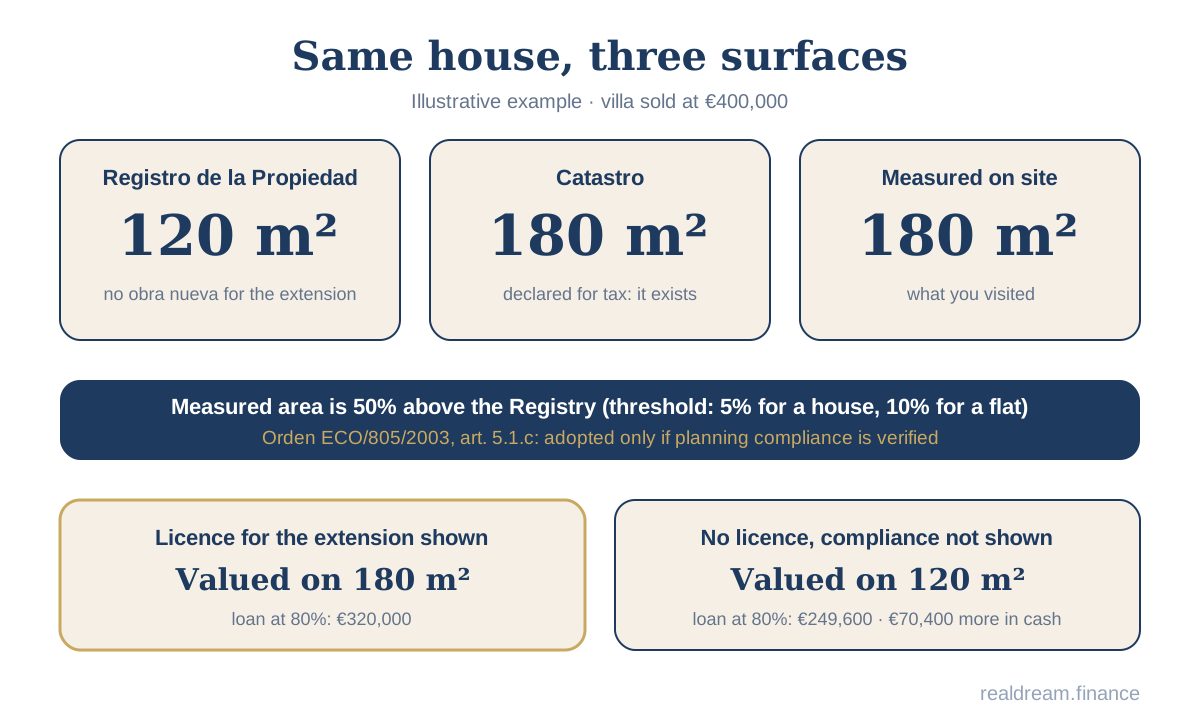
- Article 5.1.c — when that measured surface is more than 5% larger than the registered or the catastral surface, or when the building has no declaration of new construction (declaración de obra nueva) registered, the valuer may only adopt it after verifying that it complies with the applicable planning rules. For a unit inside a building (a flat, an apartment) the threshold is 10%.
- Article 8.1 — the valuer must work with a registry certificate or nota simple and with the catastral description and map, both issued within the three months before the valuation.
So the extra square metres are not ignored because they are unregistered. They are excluded from the valuation when nobody can show they are legal. A buyer who reads only the nota simple will not see this coming, because the nota simple shows what was declared, not what was built.
Why the Registry and the Catastro tell different stories
The two records answer different questions, and neither updates the other automatically.
| Registro de la Propiedad | Catastro | |
|---|---|---|
| Purpose | Ownership, charges, legal description | Physical and tax description |
| Run by | Property registrars (Ministry of Justice) | Dirección General del Catastro (Ministry of Finance) |
| Legal weight | Its legal statements prevail | Data “presumed true” unless proven otherwise, without prejudice to the Registry (art. 3.3, Catastro law) |
| How a new extension gets in | Deed of obra nueva with licence and technical certificate (art. 28 TRLSRU, art. 202 Ley Hipotecaria) | Owner’s declaration of the alteration (art. 13, Catastro law), or an inspection |
| What you get | Nota simple or registry certificate | Catastral certificate, free on the Sede Electrónica |
Since Ley 13/2015, the Registry uses catastral cartography as its graphic base (art. 10 Ley Hipotecaria), and every registry extract must say whether the plot is coordinated with the Catastro at a given date (art. 10.4). That line on the nota simple — finca coordinada or no coordinada — is the first thing to look for. “Not coordinated” does not mean something is wrong, but it means the two records have never been formally reconciled.
The common pattern on older villas is the one in the table: an owner built a porch, a guest flat or an extra floor, the Catastro picked it up through an aerial review or a declaration, and the Registry never did, because registering it requires paperwork the owner did not have. The reverse also happens: an inherited finca registered decades ago with a plot size nobody ever measured.
What the valuer does with a discrepancy
The order gives the valuer three tools, and which one is used decides how much the bank lends.
| Situation | What ECO/805/2003 requires | Effect on your loan |
|---|---|---|
| Small differences that do not cast doubt on the property or its value | A warning (advertencia), art. 11.a | Valuation usable; loan normally unaffected |
| Measured surface more than 5% (villa) or 10% (flat) above Registry or Catastro, or no obra nueva registered | Surface adopted only if planning compliance is verified, art. 5.1.c | If compliance cannot be shown, the extra area drops out of the value |
| Property not compliant with planning rules | A warning, art. 11.b, unless a condition has been issued | Valuation usable, but the bank sees the warning and applies its own policy |
| Reasoned doubts about the physical or registry identity of the property | A condition (condicionante), art. 10.1.e | Under art. 9, a conditioned value cannot be used for the mortgage purposes the order covers until it is lifted (art. 14) |
The last row is the true “mortgage refused” scenario, and it is narrower than most guides suggest. A condition is triggered when the valuer cannot be sure which property is being valued or whether the features used in the valuation exist — for instance a plot whose boundaries on the ground do not match either record. An unregistered extension on an otherwise well-identified house usually lands in the second row instead: the house is valued, but on the documented surface.
How the mismatch shrinks the mortgage: a worked example
The Banco de España’s consumer portal states that the loan is linked to the valuation, “normally up to a maximum of 80%” of it. Most lenders also apply that percentage to the lower of the purchase price and the valuation. The figures below are illustrative, not a market quote.
| As advertised | As valued | |
|---|---|---|
| Purchase price | €400,000 | €400,000 |
| Built surface used | 180 m² (what you visited) | 120 m² (registered; 60 m² extension without licence) |
| Value per m² used by the valuer | €2,600 | €2,600 |
| Valuation | €468,000 | €312,000 |
| Reference value for the loan (lower of price and valuation) | €400,000 | €312,000 |
| Loan at 80% | €320,000 | €249,600 |
| Cash you need, before taxes and fees | €80,000 | €150,400 |
The bank has not refused anything. It has offered €70,400 less, and the gap has to come from your savings — on top of transfer tax, notary and registry costs, none of which shrink because the valuation did. This is the moment many buyers discover the problem: with the deposit already paid, after the valuation report arrives.
If you want the property’s paperwork checked against the Registry, the Catastro and the town hall before you sign the arras, our property due diligence does that cross-check and tells you which of the rows above your house falls into.
How to spot it before you pay a deposit
The nota simple is necessary but not sufficient. The check takes three documents, and the third is the one most buyers skip.
- Nota simple (Registro de la Propiedad): registered built surface, plot size, whether a declaración de obra nueva is registered, and the line on Catastro coordination.
- Catastral certificate (Sede Electrónica del Catastro, free with the referencia catastral): built surface by use, year of construction, and the graphic map of the plot.
- Town hall records (Ayuntamiento): the building licence for each part of the house, the licencia de primera ocupación or equivalent, and whether any planning infringement file (expediente de disciplina urbanística) is open.
Then compare all three against the listing and against what you saw. Three red flags matter most:
- The listing surface is more than 5% larger than the registered surface on a house, or more than 10% on a flat: that is exactly the threshold in article 5.1.c.
- The nota simple describes a plot (solar, parcela) or a smaller house, with no obra nueva registered for what stands on it.
- The Catastro shows the extension but the Registry does not: the owner declared it for tax, which proves it exists, not that it is legal.
Fixing it: who does it, and how long it can take
The fix depends on whether the difference is about the plot or about the building, and the law treats them differently.
Plot size (cabida). Under article 201.3 of the Ley Hipotecaria, no formal procedure is needed when the difference does not exceed 10% of the registered area and is evidenced by a catastral certificate that fully matches the registered plot, or when it does not exceed 5%. The registrar must still have no reasoned doubts. Beyond those thresholds, the owner has to go through the notarial procedure of article 201.1, with neighbours notified.
Buildings. Article 201.1.e is explicit: the rectification procedure cannot be used to correct the description of buildings. An extension has to be registered as a declaración de obra nueva, and there are two routes under article 28 of the TRLSRU (the Spanish land and urban regeneration law):
| Route | When it applies | What it takes |
|---|---|---|
| Ordinary, art. 28.1 | The extension had, or obtains, a licence | Licence or equivalent authorisation, a technician’s certificate that the work matches the project, and the documents required for occupation |
| By age, art. 28.4 | The town hall can no longer order demolition because the limitation period has run out | A certificate from the town hall or a technician, a notarial deed, or the catastral certificate, showing the work was finished by a given date; the registrar checks no infringement file is noted, and then notifies the town hall |
The second route is not an amnesty. The building is registered, but the town hall is notified and can record the specific planning status of the work in the margin of the registry entry (art. 28.4.c), and the limitation period itself is set by regional law and varies between regions. A bank’s valuer will then read that entry.
Either way, it is the seller’s paperwork to complete. The practical lever for a buyer is timing: make regularisation, or an adjusted price, a condition of the arras, and tie the deposit to a financing clause that covers the valuation, not only the bank’s approval.
What to ask the seller, in one paragraph
Ask for the nota simple, the catastral certificate, the licence for each part of the house and confirmation that no planning file is open — and ask before the deposit, not after the valuation. A seller who has all four will hand them over in a day. A seller who answers “everybody here has the same issue” is telling you that the 60 m² you are paying for may not be in the bank’s figure.
Sources
- BOE — Orden ECO/805/2003, normas de valoración de bienes inmuebles (arts. 5, 7, 8, 9, 10, 11, 14; text in force since 12/08/2025)
- BOE — Ley Hipotecaria (arts. 10, 201, 202)
- BOE — Real Decreto Legislativo 7/2015, texto refundido de la Ley de Suelo y Rehabilitación Urbana (art. 28)
- BOE — Real Decreto Legislativo 1/2004, texto refundido de la Ley del Catastro Inmobiliario (arts. 3, 13)
- BOE — Orden ECM/599/2025, modifying Orden ECO/805/2003
- Banco de España — La tasación no solo es un mero trámite (Portal del Cliente Bancario, 12/03/2024)
Frequently asked questions
Will a Spanish bank refuse a mortgage if the Registry and Catastro don't match?
Rarely on that ground alone. The usual effect is a lower valuation: under article 5.1.c of Orden ECO/805/2003 the valuer can adopt a measured surface more than 5% above the registered or catastral one (10% for a flat) only after verifying planning compliance. A refusal follows when the valuer issues a condition because the property cannot be reliably identified.
Which surface does the mortgage valuer use?
The surface the valuer measures on site, under article 5.1 of Orden ECO/805/2003. If it cannot be measured, the lower of the registered and catastral surfaces. If the measured area exceeds the documented one by more than 5% for a house or 10% for a flat, or no declaración de obra nueva is registered, it is used only once planning compliance is verified.
Which prevails, the Registro de la Propiedad or the Catastro?
For legal matters, the Registry. Article 3.3 of the Catastro law presumes catastral data true unless proven otherwise, but without prejudice to the Registro de la Propiedad, whose legal statements prevail. Since Ley 13/2015, the Registry uses catastral cartography as its graphic base and states whether each plot is coordinated.
Can a plot size difference be corrected without a formal procedure?
Yes, within limits. Article 201.3 of the Ley Hipotecaria allows the difference to be recorded without a procedure when it does not exceed 10% of the registered area and a matching catastral certificate proves it, or when it does not exceed 5%. The registrar must have no reasoned doubts.
How is an unregistered extension legalised in the Registry?
Through a declaración de obra nueva under article 28 of the TRLSRU: with the licence and a technician's certificate, or, when the town hall can no longer order demolition because the limitation period has expired, with proof of the completion date. Article 201.1.e of the Ley Hipotecaria rules out the ordinary rectification procedure for buildings.
Does the nota simple show whether an extension is legal?
No. The nota simple shows what is registered: surface, plot, charges and whether a declaración de obra nueva exists. It does not show what was built later without registration. Compare it with the catastral certificate and with the licences held by the town hall.
Roberta
Credit intermediary registered with the Banco de España (ICI)
Want us to take care of it?
We cross-check the nota simple, the Catastro and the town hall licences before you sign the arras, so the valuation holds no surprises.