Mortgages & Banks
Euro Mortgage, Foreign Salary: Spain Treats It as a Foreign-Currency Loan

In brief
Usually, yes. Article 4.27 of Ley 5/2019 defines a foreign-currency loan as one in a currency different from your country's or from the currency of the income that repays it. A euro mortgage paid from pounds or dollars meets the second test, which brings a conversion right, a 20% stress example in the FEIN and periodic warnings.
Most guides treat a euro mortgage paid from a sterling salary as an ordinary Spanish mortgage with a currency problem attached. Spanish law reads it differently. The definition in the mortgage credit law looks at the currency you earn in, not only at the currency of the loan, and that one word — “or” — decides whether a set of borrower protections applies: a right to convert the debt, mandatory warnings at 20%, and a 20% stress example in the binding offer. This guide goes through the text, what it changes for a borrower paid in pounds, dollars or francs, and what it does not do.
Is a euro mortgage a foreign-currency loan if you earn in pounds?
Read literally, yes. Article 4.27 of Ley 5/2019 (the Spanish mortgage credit law, LCCI) defines a loan “denominated in a foreign currency” as any property loan denominated in a currency different from either of two references:
- the currency of the EU member state where the borrower lives, or
- the currency in which the borrower, when the contract is signed, holds the assets or receives the income used to repay the loan.
The two tests are alternatives. A euro loan to someone living in Spain and paid in euros fails both, so it is a domestic loan. A euro loan to someone living in Manchester and paid in pounds meets the second test: the loan is in euros, the income that repays it is in sterling. The same applies to a salary in US dollars, Swiss francs, Swedish kronor or Norwegian kroner.
The reason this is missed is that most explanations — including the Banco de España’s own consumer guide, which describes multi-currency mortgages as loans “repayable in a currency other than the euro” — are written for a borrower who lives in Spain and earns in euros. For that reader the two tests collapse into one. For a non-resident buyer, who by definition earns abroad, they do not.
| Your situation | Loan currency | Foreign-currency loan under art. 4.27? | Why |
|---|---|---|---|
| Live in Spain, salary in euros | EUR | No | Neither test is met |
| Live in France or Germany, salary in euros | EUR | No | Euro is both the residence and income currency |
| Live in the UK, salary in pounds | EUR | Yes | Income currency (GBP) differs from the loan currency |
| Live in Sweden, salary in kronor | EUR | Yes | Both tests met: SEK is the residence and income currency |
| Live in the US, salary in dollars, savings in euros used to repay | EUR | Arguably no | The test also counts the assets used to repay |
The last row matters: the definition speaks of the assets or income “with which to repay the loan”. A borrower who will service the mortgage from a euro-denominated rental income or a euro savings account is in a different position from one converting a monthly salary.
What changes when the law classifies your loan this way
Once a loan falls under article 4.27, article 20 of the LCCI applies, and it adds four obligations that a domestic euro loan does not carry.
| Protection | Where it is | What it means in practice |
|---|---|---|
| Right to convert the debt | Art. 20.1 | You can ask to switch the loan into an alternative currency |
| Periodic information on the debt | Art. 20.3 + Orden EHA/2899/2011, art. 31 | The lender tells you what you owe, how much it has grown and how to convert |
| Mandatory warning at 20% | Art. 20.4 + Annex I | Information must be sent at least when the exchange rate moves more than 20% (see the caveat below) |
| 20% stress example in the offer | Art. 20.5 + Annex I (FEIN) | Your binding offer must show what happens if your currency loses 20% |
The pre-contract paperwork also changes. Under article 14.1.b, the standardised warnings sheet (FiAE) must state that the loan is a foreign-currency loan, and under article 15.2.c the notary has to give you individual advice on each specific clause of the FEIN and the FiAE before you sign — a generic statement is not enough.
The right to convert: what article 20.1 actually offers
The conversion right lets you move the debt into one of two “alternative currencies”, chosen when you make the request:
- (a) the currency in which you receive most of your income or hold most of the assets used to repay, as stated in the most recent solvency assessment for the loan; or
- (b) the currency of the member state where you were resident when the contract was signed, or where you are resident when you ask.
Two details are absent from the guides ranking for this question.
Option (b) does not exist for a UK, US or Swiss resident. It refers to a member state of the EU. A borrower living in the United Kingdom since Brexit, or in the US, Switzerland or Norway, can rely only on option (a), which is tied to what the bank recorded about your income at its last solvency assessment. If your income currency changes later — you move to the eurozone, or start being paid in euros — option (b) becomes available only once you are resident in a member state.
The exchange rate is fixed by law unless the contract says otherwise. Article 20.1 sets the rate in force on the date you request the conversion, and, unless the contract provides differently, the one published by the European Central Bank on that date. Check whether your draft contract replaces the ECB rate with the lender’s own rate: the law allows it, so it is worth reading.
What the right does not give you: a fixed rate of exchange from the day you signed, compensation for past movements, or a guarantee that converting is a good idea. Converting a euro debt into sterling turns a currency risk into a sterling debt secured on a property valued in euros. It changes which risk you carry; it does not remove risk.
The 20% rule, and the arithmetic behind it
The law and the FEIN both use the figure 20%, and the FEIN template in Annex I phrases it from your side: “if the value of [your national currency] fell by 20% against [the loan currency]”. That sentence produces a larger increase in what you pay than most readers expect.
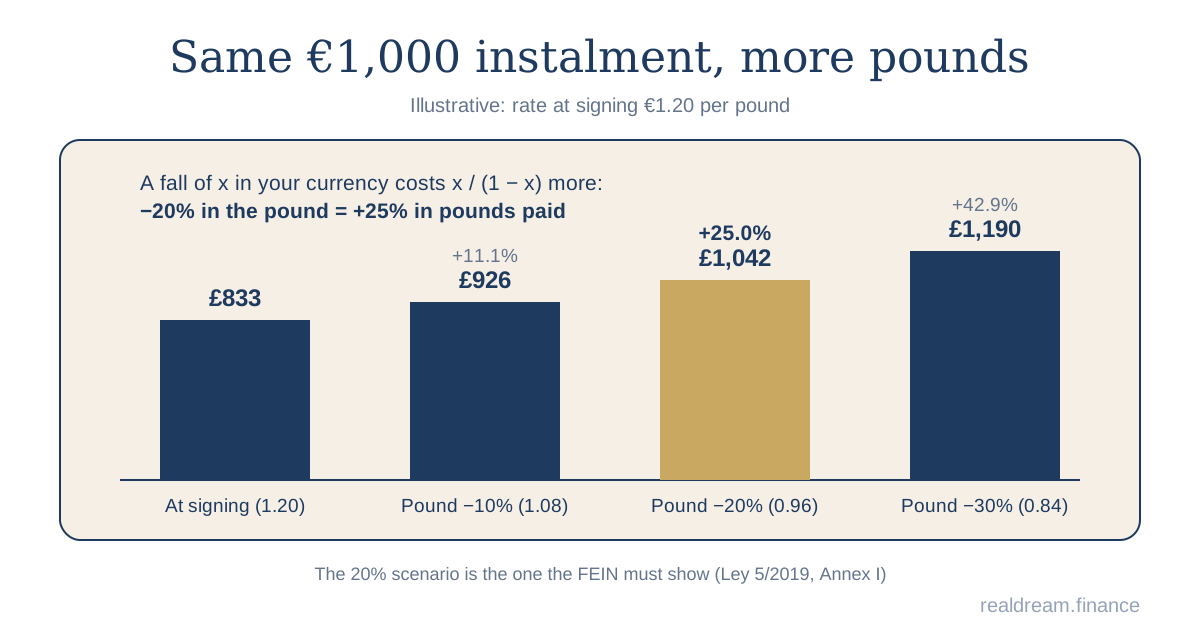
Take an illustrative monthly instalment of €1,000 and an illustrative rate of €1.20 per pound:
| Euros per pound | Instalment in euros | Cost in pounds | Change | |
|---|---|---|---|---|
| At signing | 1.20 | €1,000.00 | £833.33 | — |
| Pound falls 10% | 1.08 | €1,000.00 | £925.93 | +11.1% |
| Pound falls 20% | 0.96 | €1,000.00 | £1,041.67 | +25.0% |
| Pound falls 30% | 0.84 | €1,000.00 | £1,190.48 | +42.9% |
The pattern is not linear: a fall of x in the value of your currency raises the instalment in your currency by x / (1 − x). A 20% fall costs 25% more, a 30% fall costs almost 43% more. The euro figure on your bank statement never moves, which is why the risk is easy to underestimate — the change happens in the account your salary lands in.
Where the text does not fit a euro loan
There is one point where Spanish law was clearly drafted with a euro earner in mind. Article 20.4 triggers the mandatory information when the debt or the instalments differ by more than 20% from what they would have been at “the exchange rate between the currency of the loan and the euro” on the signing date. For a loan in euros, that rate is always 1: read word for word, the trigger can never fire, however far the pound falls.
The FEIN instructions in Annex I are worded more broadly: when the loan currency differs from the borrower’s national currency, the lender must state that the borrower will receive warnings “at least when the exchange rate fluctuates by more than 20%”. Which reading your lender applies is something to ask before signing, not to discover after a bad year for sterling.
This is also why the FEIN, in section 3 (“main features of the loan”) and section 6 (“amount of each instalment”), must carry two statements when your loan is in a currency other than your own: the 20% example in your currency, and a prominent warning that the increase could be higher than the example. Annex I adds that the lender must name the body that publishes the exchange rate used and the date on which it is calculated.
How the bank assesses a salary paid in pounds
The currency risk is weighed twice: once by the bank before it lends, and once by you afterwards.
Article 11.1 of the LCCI requires the lender to assess “in depth” your solvency on the basis of present income and the income foreseeable over the life of the loan, along with assets, savings, fixed expenses and commitments already assumed. A salary that is stable in sterling is not stable in euros, so lenders apply an internal discount to foreign-currency income before calculating affordability.
How big that discount is depends on each bank. Article 11.2 requires lenders to have internal procedures for the assessment, reviewed by themselves and supervised by the Banco de España, but the law sets no percentage. Figures quoted online are market observations, not a rule, and they differ between lenders and between currencies.
Two consequences follow from the text:
- The assessment cannot lean on the property. Under article 11.3, solvency cannot be based predominantly on the property being worth more than the loan. A larger deposit lowers the loan-to-value, but your converted income still has to carry the instalment.
- What the bank records sets your conversion option. Option (a) of article 20.1 points to the currency stated “at the most recent solvency assessment”. If part of your repayment capacity is in euros — a rental income in Spain, a euro account — make sure it is documented in the file, because that record later defines which currency you can convert into.
Many borrowers discover at this stage that the problem is not whether the bank accepts foreign income, but how it is converted and documented. If you’d like an early read on how a Spanish lender is likely to treat your sterling or dollar income, the non-resident mortgage pre-assessment asks for the core figures and takes a few minutes, free and with no commitment.
What happens if the lender skips these rules
Article 20.6 sets the consequence: failure to meet any of the article’s requirements makes the “multi-currency clauses” void in favour of a consumer borrower, and allows the borrower to ask for the contract to be modified so that the loan is treated as granted from the start in the currency of the borrower’s main income.
That remedy was written with classic multi-currency loans in mind — loans in yen or Swiss francs to euro earners. How Spanish courts apply it to a plain euro loan repaid from a foreign salary is a question for a lawyer reading your specific contract, not for a general guide. What you can do without one is check, before signing, whether your documents treat the loan as a foreign-currency loan:
| Document | What to look for |
|---|---|
| FEIN, section 3 | “This loan is not expressed in [pounds]” and a 20% example in your currency |
| FEIN, section 6 | The instalment example in your currency and the source and date of the exchange rate |
| FiAE | A reference to the loan being a foreign-currency loan |
| Draft contract | The conversion clause, the exchange rate to be applied (ECB or the lender’s) and the frequency of information |
| Notary’s record (acta) | Individual advice on each of those clauses |
If none of these appears and your income is in another currency, ask the lender in writing how it has classified the loan and why.
Buying through a company changes the rules
The conversion right is a consumer right. Article 20.2 allows borrowers who are not consumers — for example a company buying a property — to agree with the lender on a different system to limit exchange-rate risk instead of the conversion right. The 20% warnings and periodic information still form part of the article, but the core protection can be negotiated away. If you are buying through a holding company or a business structure, read that clause with particular care.
Practical steps before you sign
- Decide which currency will repay the loan and document it: salary, pension, rental income or savings. It fixes the classification under article 4.27 and the conversion option under article 20.1.
- Build your own stress test with the x / (1 − x) rule: check that a 20% and a 30% fall in your currency still leave the instalment affordable.
- Read the FEIN at sections 3 and 6 and the FiAE for the foreign-currency statements described above.
- Ask which exchange rate the contract uses for conversion and whether it is the ECB rate.
- Ask in which currency you will receive the periodic information. Under article 31 of Orden EHA/2899/2011, you can choose between your main income currency, your main asset currency or euros; when settlements are less frequent than quarterly, the information must reach you within 20 days of the end of each calendar quarter.
- Use the notary meeting. The pre-signing session under article 15 exists for these questions, and the answers go on record.
Sources
- BOE — Ley 5/2019, reguladora de los contratos de crédito inmobiliario (arts. 4.27, 11, 14, 15, 20 and Annex I: FEIN)
- BOE — Orden EHA/2899/2011, de transparencia y protección del cliente de servicios bancarios (art. 31: information on foreign-currency loans)
- Banco de España — Multi-currency mortgages (Portal del Cliente Bancario)
Frequently asked questions
Is a euro mortgage a foreign-currency loan if I earn in pounds?
Read literally, yes. Article 4.27 of Ley 5/2019 covers loans in a currency different from that of the member state where you live or from the currency of the income or assets that repay the loan. A euro loan repaid from a sterling salary meets the second test.
Can I convert my Spanish euro mortgage into pounds?
Article 20.1 of Ley 5/2019 gives consumers a right to convert a foreign-currency loan into the currency of most of their income or assets, as recorded at the latest solvency assessment, or into the currency of their EU member state of residence. A UK resident can use only the first option.
Which exchange rate applies if I convert the loan?
The rate in force on the date you request the conversion. Unless the contract says otherwise, it is the rate published by the European Central Bank on that date, under article 20.1 of Ley 5/2019. Check whether your draft contract replaces it with the lender's own rate.
If the pound falls 20%, how much more do I pay?
25% more in pounds. The euro instalment stays the same, but each euro costs 1 / 0.8 = 1.25 times as many pounds. A fall of x in your currency raises the cost by x / (1 − x), so a 30% fall costs almost 43% more.
How much of my foreign income will a Spanish bank count?
There is no legal percentage. Article 11 of Ley 5/2019 requires an in-depth assessment of present and foreseeable income, and each lender applies its own internal procedure, supervised by the Banco de España. Many apply a discount to income in another currency.
Do these protections apply if I buy through a company?
Not in full. Article 20.2 of Ley 5/2019 lets borrowers who are not consumers agree with the lender on a different mechanism to limit exchange-rate risk instead of the conversion right.
Roberta
Credit intermediary registered with the Banco de España (ICI)
Want us to take care of it?
We read your foreign income the way a Spanish underwriter will — converted, discounted and documented — before you commit to a property.