
Non-Resident Tax
Non-EU Landlords in Spain: Taxed on Gross Rent, Not Profit
In brief
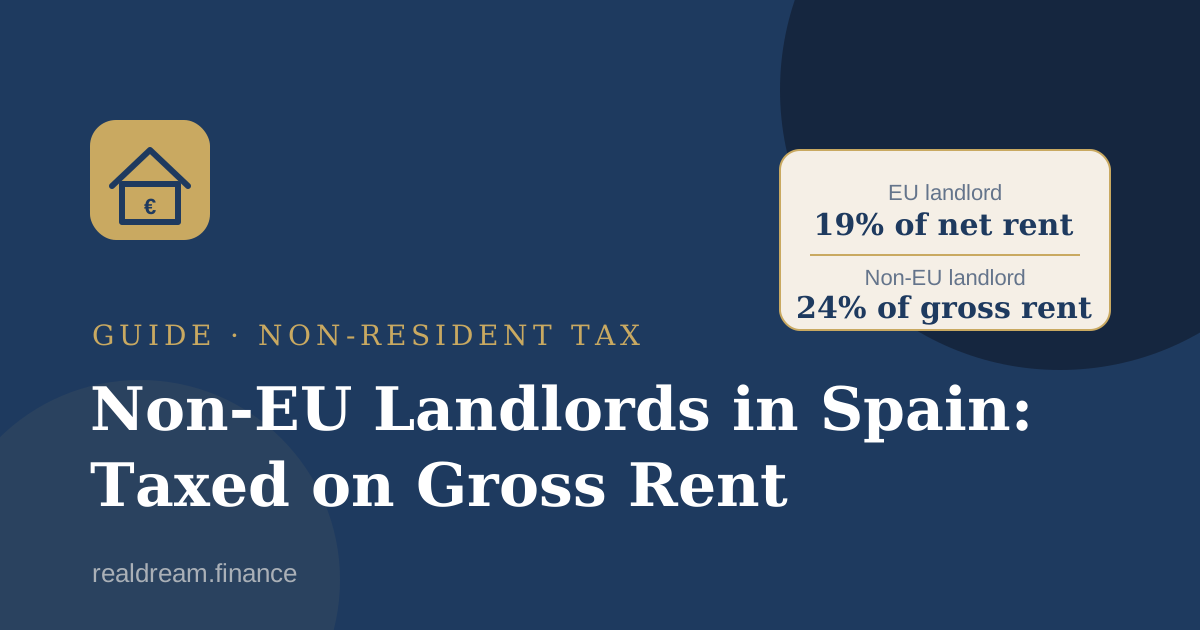
A landlord living outside the EU/EEA pays 24% on the gross rent from a Spanish property, with no expenses deducted; an EU or EEA landlord pays 19% on rent minus expenses (arts. 24 and 25 TRLIRNR). The base, not the rate, drives the gap. A Supreme Court appeal admitted in July 2026 will decide if this breaches EU law; until then, the rule applies.
If you live outside the EU and the European Economic Area and let a property in Spain, the headline you keep reading — “19% for EU residents, 24% for everyone else” — hides the part that costs more. Under article 24 of the Spanish Non-Resident Income Tax Act (texto refundido de la Ley del Impuesto sobre la Renta de no Residentes, TRLIRNR), an EU or EEA landlord pays on rent minus expenses, while a landlord resident in the UK, the US, Switzerland or any other third country pays on the full rent. The five points of rate are the small part of the gap. The base is the big one.
How much more does a non-EU landlord actually pay?
A non-EU landlord pays 24% on gross rent; an EU landlord pays 19% on net rent. On a let with ordinary running costs, like the one below, that turns a 24% headline into 46.45% of the real profit.
The difference comes from two separate rules:
- Article 24.1 TRLIRNR sets the general taxable base for non-residents as the importe íntegro — the full amount of the income — with no expenses deducted.
- Article 24.6 TRLIRNR creates the exception: residents of another EU member state, and of EEA states with effective tax-information exchange with Spain, may deduct the expenses allowed under the Spanish personal income tax act (Ley 35/2006), provided they prove the expenses are directly linked to the Spanish income.
- Article 25.1.a) TRLIRNR sets the rate: 24% as a general rule, 19% for the same EU/EEA group.
UK residents moved from the first group to the second when the Brexit transition period ended on 31 December 2020. A British owner letting the same flat in Alicante in 2020 and in 2021 went from netting expenses at 19% to paying 24% on every euro of rent.
A worked example: the same flat, three tax bills
Take a flat let all year for €12,000, with these annual costs: IBI (council tax) €600, community fees €1,200, insurance €300, mortgage interest €1,500, repairs €400 and depreciation of €1,800 (3% of a €60,000 building value, excluding land). Total expenses: €5,800. Net rent: €6,200.
| Landlord resident in | Taxable base | Rate | Tax due | Tax as % of net rent |
|---|---|---|---|---|
| Germany, France, Ireland (EU) | €6,200 | 19% | €1,178 | 19.0% |
| UK, US, Switzerland (non-EU), as the law reads today | €12,000 | 24% | €2,880 | 46.45% |
| UK, US, Switzerland, if the deduction were recognised | €6,200 | 24% | €1,488 | 24.0% |
The rate difference between the first and third rows is €310. The base difference between the second and third rows is €1,392 a year. That is why the argument now in front of the Spanish courts is about the base, not the rate.
Which expenses would an EU landlord deduct?
An EU or EEA landlord deducts the expenses listed in article 23.1 of Ley 35/2006 (the Spanish personal income tax act, LIRPF), under the proof requirement of article 24.6 TRLIRNR.
- Financing and upkeep: interest on the loan used to buy or improve the property, plus repair and maintenance costs. Together these cannot exceed the rental income of that property in the year; the excess carries forward for four years.
- Local taxes and charges: IBI, the waste collection charge and similar levies, as long as they are not fines.
- Services paid to third parties: community fees, a letting agent, a property manager.
- Depreciation: up to 3% a year of the higher of the purchase cost or the cadastral value, excluding the land.
What no non-resident gets — EU residents included — are the reductions for residential lets in article 23.2 LIRPF (today between 50% and 90% of the net income for a Spanish resident, depending on the contract). Article 24.1 TRLIRNR excludes them expressly: “ni las reducciones”. A guide that tells a non-resident about “the 60% reduction for long-term lets” is describing a resident’s tax return.
From 1 January 2027 the Modelo 210 will also carry a separate annex breaking down deductible expenses for let properties, approved by Orden HAC/623/2026 (BOE of 23 June 2026). The Agencia Tributaria will see each line, not just a total — so the paperwork behind each expense matters more than before.
Is the non-EU rule being challenged in court?
Yes, and it is not settled. On 15 July 2026 the Spanish Supreme Court admitted a cassation appeal (ATS 7675/2026, appeal no. 6741/2025) against an Audiencia Nacional ruling that let a non-EU resident deduct expenses. The Supreme Court has not decided the case; it has agreed to decide it.
Many English-language guides published after the Audiencia Nacional ruling say that non-EU owners “can now deduct expenses”. That overstates it. The ruling applied to one taxpayer, the State appealed, article 24.6 TRLIRNR has not been amended, and the Agencia Tributaria continues to apply it as written.
The order admitting the appeal frames two questions, and the second is the one most coverage leaves out:
- Whether taxing third-country residents on gross rent while EU/EEA residents are taxed on net rent is a restriction on the free movement of capital under article 63 of the Treaty on the Functioning of the EU (TFEU). Unlike the other EU freedoms, article 63 also protects movements of capital between member states and third countries — which is why a US or UK resident can invoke it at all.
- If it is a restriction, whether it is protected by the standstill clause of article 64.1 TFEU, or justified under article 65 TFEU. Article 64.1 allows member states to keep restrictions on capital movements to or from third countries that existed on 31 December 1993 and involve direct investment “incluidas las inmobiliarias” — real estate is named in the text. Article 65 lets member states apply tax rules that distinguish taxpayers by place of residence, provided they are not arbitrary discrimination.
The outcome therefore depends on points of EU law that cut both ways. The Supreme Court order also notes that another appeal (no. 3915/2026) raises identical questions, so one judgment is likely to settle both.
What a non-EU landlord can do while the case is pending
A non-EU landlord has three positions available, and each carries a different risk:
- Keep filing on gross rent and do nothing else. No dispute with the Agencia Tributaria, but if the Supreme Court sides with taxpayers, years older than four at that point are lost: the right to ask for a refund expires after four years (article 66.c of the General Tax Act, Ley 58/2003).
- Keep filing on gross rent and ask to rectify past returns. Article 120.3 of Ley 58/2003 lets a taxpayer ask for a self-assessment to be rectified, and article 68.3 says any documented request of this kind interrupts the four-year clock. The Agencia Tributaria is likely to reject it while the law stays unchanged; the request’s value is that it keeps those years alive.
- Deduct expenses directly on the return. This applies the Audiencia Nacional reasoning before the Supreme Court has confirmed it. Expect the Agencia Tributaria to reassess the return and claim the difference with late-payment interest, and to defend the position through the appeal route.
Which one fits depends on the size of your expenses, how many years are at stake and your appetite for a dispute — a decision to take with a tax adviser who knows your file. If you’d like that decision made each year on your own figures, the non-resident tax service prepares the Modelo 210 for let properties, including the split between let days and empty days.
When the property is not let all year
An empty period creates a second tax, even for a non-EU owner. For the days the property is not let and remains available to you, the law imputes a notional income under article 24.5 TRLIRNR, calculated as set out in article 85 LIRPF: 2% of the cadastral value per year, or 1.1% if the municipality’s values were revised in the last ten years, prorated by days.
On a flat with a revised cadastral value of €90,000, let for 245 days and empty for 120, the imputed income is €90,000 × 1.1% × 120/365 = €325.48. At 24%, that adds €78.12 of tax for a non-EU owner, on top of the tax on the rent.
The same Orden HAC/623/2026 adds two boxes to the Modelo 210 from 2027: “Nº de días” (days let, or days available to the owner) and “Cuota participación” (the owner’s percentage share of the property). Co-owners each file their own return on their own share.
When a Spanish company pays the rent
If the tenant is a Spanish company, or a Spanish resident individual renting the property for a business activity, the tenant must withhold tax on the rent (article 31.1 TRLIRNR). Article 31.2 says the withholding is calculated without applying article 24.6 — that is, on the gross rent, even when the landlord lives in the EU.
When the tenant has withheld, article 28.3 TRLIRNR releases the landlord from filing a Modelo 210 for that income. For a non-EU landlord taxed on gross rent, the withholding usually equals the final tax. An EU landlord with deductible expenses ends up over-withheld: the withholding does not apply the deductions, so recovering the difference means filing a Modelo 210 with the expenses.
New filing deadlines for rental income
Rental income accrued from 2026 onwards is filed in the first 20 calendar days of April of the following year, whether you group the year’s income into one annual return or declare each period separately. This is the change introduced by Orden HAC/623/2026:
| Income | Filing window | First applies to |
|---|---|---|
| Rent, annual grouping (income types 01 and 35) | 1–20 April of the following year | Income accrued in 2026 (filed in April 2027) |
| Rent, declared separately | 1–20 April of the following year | Income accrued from October 2026 |
| Imputed income on empty periods (type 02) | 1 April – 31 December of the following year | 2026 income (filed from April 2027) |
If you pay by direct debit, the window closes earlier: 1 to 15 April for rent, and 23 December for imputed income. Before this order, rental income grouped annually was filed in the first 20 days of January; anyone with a January reminder set for their 2026 rent should move it to April 2027.
Sources
- BOE — Real Decreto Legislativo 5/2004, texto refundido de la Ley del Impuesto sobre la Renta de no Residentes (arts. 10, 24, 25, 28 and 31)
- BOE — Ley 35/2006, del Impuesto sobre la Renta de las Personas Físicas (art. 23: deductible expenses and reductions; art. 85: imputed income)
- BOE — Orden HAC/623/2026, de 12 de junio, amending Modelo 210 (new deadlines and deductible-expenses annex)
- Agencia Tributaria — Note on the Modelo 210 deadline changes introduced by Orden HAC/623/2026
- BOE — Ley 58/2003, General Tributaria (arts. 66, 68.3 and 120.3: four-year limitation and rectification of self-assessments)
- CENDOJ (Consejo General del Poder Judicial) — Auto del Tribunal Supremo of 15 July 2026, ATS 7675/2026, appeal no. 6741/2025
- EUR-Lex — Treaty on the Functioning of the European Union, articles 63, 64 and 65
Frequently asked questions
Can a UK resident deduct expenses from Spanish rental income?
Not under the law as it stands. Since the Brexit transition ended on 31 December 2020, UK residents fall outside article 24.6 TRLIRNR, which limits deductions to EU residents and EEA states with effective tax-information exchange. They pay 24% on the gross rent. A Supreme Court appeal admitted on 15 July 2026 will decide whether this is compatible with EU law.
Did a Spanish court rule that non-EU owners can deduct rental expenses?
The Audiencia Nacional did, for one US-resident taxpayer. The State appealed, and on 15 July 2026 the Supreme Court admitted the case (ATS 7675/2026). The law has not changed, and the Agencia Tributaria still applies article 24.6 TRLIRNR as written until the Supreme Court rules.
When is the Modelo 210 for 2026 rental income due?
Between 1 and 20 April 2027, under Orden HAC/623/2026. The April window applies whether you group the year's rent into one return or declare periods separately (for separate returns, from income accrued in October 2026). With direct debit, the window closes on 15 April.
Do non-residents get the 50% to 90% reduction for long-term residential lets?
No. Article 24.1 TRLIRNR excludes the reductions of the personal income tax act for all non-residents, including those living in the EU. The reductions in article 23.2 of Ley 35/2006 apply only to Spanish tax residents.
Can I claim back tax paid on gross rent in past years?
You can ask the Agencia Tributaria to rectify past self-assessments under article 120.3 of Ley 58/2003. The right to a refund expires after four years (article 66), and a documented request interrupts that period (article 68.3). While the law is unchanged, expect the request to be refused; its purpose is to keep those years open until the Supreme Court decides.
Do I pay tax on my Spanish property for the months it is empty?
Yes, for the days it is not let and remains available to you. Article 24.5 TRLIRNR imputes 2% of the cadastral value a year, or 1.1% where values were revised in the last ten years, prorated by days, taxed at 19% or 24% depending on where you live.
Roberta
Credit intermediary registered with the Banco de España (ICI)
Want us to take care of it?
We prepare the Modelo 210 for let properties every year — let days and empty days, expenses where the law allows them, and the April deadline tracked for you.