Non-Resident Tax
Buying Spanish Property Through a UK Company: When the 3% Annual Tax Applies
In brief
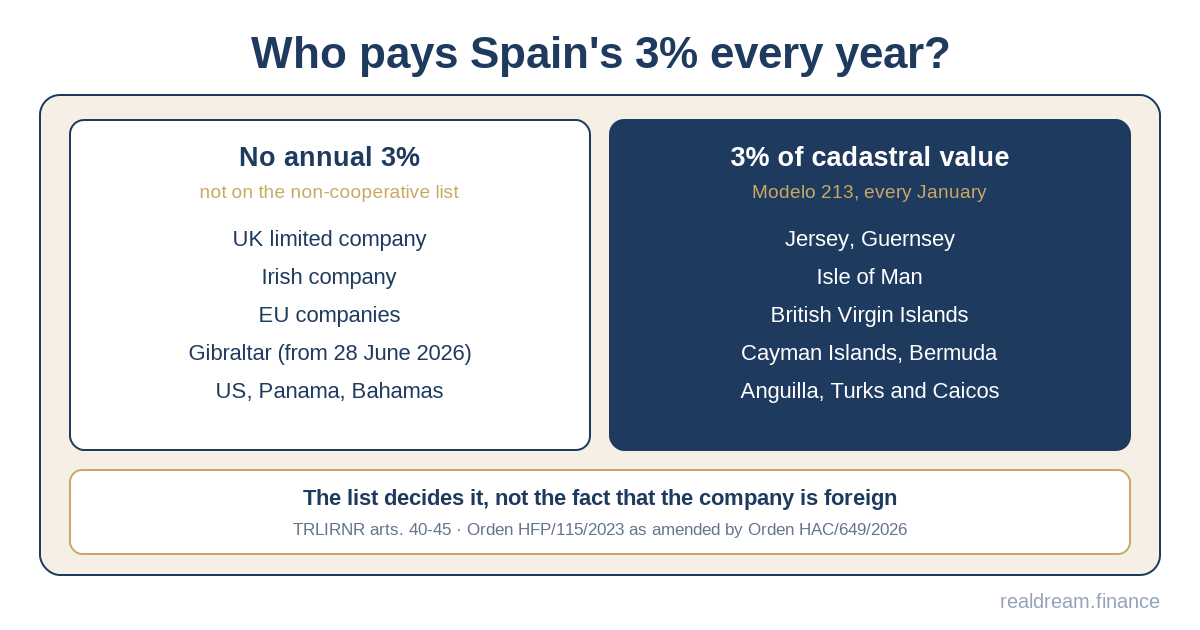
Spain's 3% annual charge on company-owned property (the gravamen especial, filed on the Modelo 213) does not apply to every foreign company. It applies only to companies resident in a jurisdiction on Spain's non-cooperative list. A UK or Irish company is not on it; Jersey, Guernsey, the Isle of Man, the British Virgin Islands and the Cayman Islands are. Gibraltar left the list on 28 June 2026.
Search for “buy Spanish property through a UK limited company” and you will read two opposite claims, often on the same page: that every foreign company pays Spain 3% of the property’s value each year, and that the tax was abolished years ago. Neither is right. The tax exists, it is collected every January, and it applies to a short list of jurisdictions that a UK or Irish company is not on. Getting this wrong in either direction is expensive: one buyer sets up an offshore vehicle believing it is neutral, another rules out a UK company for a tax it would never pay.
This guide sets out who pays the 3%, the list that decides it (changed in June 2026), what a UK company pays instead, and what a company structure does not change.
Does a UK company pay Spain’s 3% annual property tax?
No. The 3% annual charge, the gravamen especial sobre bienes inmuebles de entidades no residentes, applies only to companies resident in a jurisdiction that Spain classifies as non-cooperative. A UK limited company or an Irish company is not in that category, so it does not file the Modelo 213 and does not pay the charge.
The rule sits in article 40 of the Non-Residents’ Income Tax Act (texto refundido de la Ley del Impuesto sobre la Renta de no Residentes, TRLIRNR). Its wording still refers to entities resident “en un país o territorio que tenga la consideración de paraíso fiscal”. Since 11 July 2021, additional provision ten of Ley 36/2006, added by Ley 11/2021, states that references to tax havens in Spanish legislation “se entenderán efectuadas a la definición de jurisdicción no cooperativa”. The Agencia Tributaria applies the charge on exactly that basis.
| Company resident in | On Spain’s non-cooperative list? | Annual 3% charge (Modelo 213) |
|---|---|---|
| England, Wales, Scotland, Northern Ireland | No | Does not apply |
| Ireland | No | Does not apply |
| Jersey, Guernsey, Isle of Man | Yes | Applies |
| British Virgin Islands, Cayman Islands, Anguilla, Bermuda, Turks and Caicos | Yes | Applies |
| Gibraltar | Removed from 28 June 2026 | Does not apply going forward (see the transitional rule below) |
Many older articles that describe the 3% as a charge on all foreign companies reflect the rules before 2013, when the charge was framed differently. The current article 40, in force since 1 January 2013, starts from the list, not from the fact that the company is foreign.
The list that decides it, and what changed in June 2026
The non-cooperative list is set by ministerial order. The order in force is Orden HFP/115/2023, amended by Orden HAC/649/2026, of 21 June, published in the BOE on 27 June 2026 and in force from 28 June 2026.
The June 2026 order removed six entries: Barbados, Dominica, Gibraltar, Samoa (for its offshore business regime), Seychelles and Trinidad and Tobago. It added the Russian Federation, limited to its international holding company regime, with effect from 28 December 2026.
The entries still on the list that matter most to buyers coming from the UK and Ireland are the Crown Dependencies and the Caribbean territories that are common in UK structuring:
- Jersey, Guernsey and the Isle of Man
- British Virgin Islands, Cayman Islands, Anguilla, Bermuda, Turks and Caicos Islands
- Also listed: Bahrain, Fiji, Guam, the Falkland Islands, the Northern Mariana Islands, Palau, American Samoa, the Solomon Islands, the US Virgin Islands and Vanuatu.
Two details deserve attention before relying on the change:
- The transitional rule. Orden HAC/649/2026 keeps the previous list for tax periods not concluded when it entered into force. The 3% accrues on 31 December, so a Gibraltar company that owned Spanish property during 2026 should have its adviser confirm how that rule applies to the 2026 accrual before deciding not to file in January 2027.
- Outdated lists online. The Agencia Tributaria’s own instructions for the Modelo 213 still reproduce a longer list dated 5 October 2022. The list that binds is the one published in the BOE, in its current consolidated version.
How the 3% is calculated and filed
For a company on the list, the charge is 3% of the property’s cadastral value (valor catastral), every year, whether or not the property produces any income.
- Base: the cadastral value (article 41.1 TRLIRNR). Where the property has none, the value used for Spanish wealth tax applies instead.
- Co-ownership: if the company owns a share, the charge applies only to its proportion (article 41.2).
- Rate: 3% (article 43).
- Accrual and filing: the charge accrues on 31 December and is declared and paid in January of the following year (article 45.1), on the Modelo 213. The company files one return per Agencia Tributaria regional office, listing every property located in that office’s area.
- Deductibility: the charge counts as a deductible expense for the company’s Spanish non-resident income tax, where it has any (article 44).
On a property with a cadastral value of €180,000, the charge is €5,400 a year. Cadastral values are typically well below market values, but the charge is due every year and does not stop when the property is empty.
Article 42 exempts three categories: foreign states, public institutions and international organisations; companies that carry on in Spain, continuously or habitually, an economic activity distinct from simply holding or letting the property; and companies listed on recognised securities markets. A holiday home owned by a BVI company fits none of them.
What a UK company pays instead: tax on rent and on the sale
A UK company owning Spanish property files Spanish non-resident income tax on what the property earns. Since Brexit, it is taxed as a non-EU company, which changes both the rate and the base.
- Rental income: 24% (article 25.1.a TRLIRNR). The reduced 19% rate is reserved for residents of the EU or of an EEA state with effective exchange of tax information.
- Expenses: article 24.6 allows deductions for EU and EEA residents only. A UK company is therefore taxed on the gross rent, while an Irish company deducts expenses linked to the Spanish income under Spanish corporate tax rules and pays 19% on the net.
- Capital gain on sale: 19% (article 25.1.f), whatever the country of residence.
- Withholding on sale: when a non-resident without a permanent establishment sells, the buyer must withhold 3% of the price and pay it to the Agencia Tributaria as a payment on account (article 25.2).
This is what Spain charges at source. How the same income and gains are then taxed in the UK, and how profits are extracted from the company, is a UK tax question to settle with a UK adviser before buying.
What a company does not change
A company is often chosen for reasons the Spanish rules have already closed off. Three points are worth checking against the law itself.
Imputed income on an empty or owner-used home. Spain taxes non-resident owners on a notional income from homes that are not let. Article 13.1.h TRLIRNR limits that charge to “contribuyentes personas físicas”, individuals. A company is outside it, but that alone is a weak reason to choose one: the use of a company’s house by its shareholders raises questions in both countries that a single article does not answer.
Wealth tax. Holding the property through a company does not take it out of Spanish wealth tax for a non-resident individual shareholder. Article 5.Uno.b of Ley 19/1991 treats as located in Spain the shares of any unlisted entity whose assets consist, directly or indirectly, of at least 50% Spanish real estate. Whether any tax is actually due then depends on the thresholds and the regional rules that apply.
Inheritance. On death, the heirs inherit shares, not a Spanish property. How Spain and the UK each treat those shares is a separate analysis; do not assume the company settles it.
The extra paperwork a company buyer carries
Buying through a company adds steps that a personal purchase does not have.
- A Spanish tax number for the company. Legal entities that will have tax-relevant dealings must request a NIF (article 23.1 of Real Decreto 1065/2007), and the deed must state the NIF of every party and of those they represent (article 27.2.c).
- Beneficial owner checks. The notary and the bank are obliged under Ley 10/2010 to identify the beneficial owner before acting (article 4.1). For a company, that means any individual who owns or controls more than 25% of the capital or voting rights, or controls it by other means; where no one does, the directors are treated as the controllers (article 4.2.b).
- Legalised corporate documents. Certificates of incorporation, good standing and board resolutions authorising the purchase need an apostille. The UK has applied the Hague Apostille Convention since 1965 and Spain since 25 September 1978, so the apostille replaces consular legalisation.
- A tax representative. Under article 10.1 TRLIRNR, a taxpayer resident outside the EU must appoint a Spanish-resident representative when it operates through a permanent establishment, or when the Agencia Tributaria requires it because of the income or “la posesión de un bien inmueble”. For entities resident in territories without effective exchange of tax information, which now reads as the non-cooperative list, the same article makes the appointment compulsory for anyone holding Spanish property.
- Financing. A bank lending to a foreign company assesses a corporate borrower: its accounts, its owners and the guarantees they can offer. Appetite for this varies between Spanish banks, so it is a question to raise before the structure is set up, not after.
Buying from an offshore company: the charge that follows the property
This is the point most buyers miss, and it applies even if you buy in your own name. When a company subject to the 3% sells Spanish property, article 45.3 TRLIRNR provides that the property “quedarán afectos al pago” of the charge. In practice, unpaid years of the gravamen especial travel with the property to the new owner, and article 45.2 allows the Agencia Tributaria to enforce them directly against the property.
If the seller is a company from Jersey, the BVI or any other listed jurisdiction, ask for proof of the Modelo 213 filings and payments for the years the company has owned the property, and have the purchase contract address what happens if earlier years turn out to be unpaid. The 3% withholding on the price still applies on top, because the seller is a non-resident.
If you are weighing a company against buying in your own name, our non-resident tax service maps the Spanish filings each option creates, year by year, before you sign anything.
Personal ownership, UK company or offshore company: side by side
| In your own name | UK limited company | Irish company | Jersey, Guernsey, IoM, BVI or Cayman company | |
|---|---|---|---|---|
| Annual 3% on cadastral value | No | No | No | Yes, Modelo 213 every January |
| Spanish tax on rent | 24% on gross (UK resident) | 24% on gross | 19% on net | 24% on gross |
| Tax on an empty home | Imputed income (individuals) | Not under art. 13.1.h | Not under art. 13.1.h | Not under art. 13.1.h, but the 3% applies |
| Spanish tax representative | Only if required | Only if required | Not under art. 10.1 | Compulsory |
| Beneficial owner disclosure | Not applicable | Yes | Yes | Yes |
| A buyer from this company must check for unpaid 3% | No | No | No | Yes (art. 45.3) |
Five mistakes that cost money
- Assuming every foreign company pays 3%. The charge follows the list, not the passport of the company.
- Using an old list. Gibraltar, Barbados and the Seychelles left it in June 2026; the Modelo 213 instructions online still show an older version.
- Expecting a UK company to deduct expenses. After Brexit it pays 24% on gross rent; only EU and EEA residents deduct.
- Using a company to sidestep wealth tax. Shares in a company holding mainly Spanish property are treated as located in Spain.
- Buying from an offshore seller without checking the Modelo 213. Unpaid years remain charged on the property you are buying.
Sources
- BOE — TRLIRNR (Real Decreto Legislativo 5/2004), arts. 10.1, 13.1.h, 24.6, 25 and 40 to 45 (special charge on real estate of non-resident entities)
- BOE — Orden HFP/115/2023, list of non-cooperative jurisdictions (consolidated text)
- BOE — Orden HAC/649/2026, de 21 de junio (removes Gibraltar, Barbados, Dominica, Samoa, Seychelles, Trinidad and Tobago; adds Russia from 28 December 2026)
- BOE — Ley 36/2006, additional provisions one and ten (definition of non-cooperative jurisdiction; references to tax havens)
- Agencia Tributaria — Special charge on real estate of non-resident entities
- Agencia Tributaria — Modelo 213, instructions
- BOE — Ley 19/1991, del Impuesto sobre el Patrimonio, art. 5.Uno.b
- BOE — Ley 10/2010, de prevención del blanqueo de capitales, art. 4 (beneficial owner)
- BOE — Real Decreto 1065/2007, arts. 23 and 27 (NIF of legal entities; NIF in notarial deeds)
- HCCH — Apostille Convention, status table
Frequently asked questions
Does a UK limited company pay the 3% annual tax on Spanish property?
No. Under article 40 of the Spanish Non-Residents' Income Tax Act, read with additional provision ten of Ley 36/2006, the 3% annual charge applies only to companies resident in a jurisdiction on Spain's non-cooperative list. The UK and Ireland are not on it, so a UK or Irish company does not file the Modelo 213.
Do Jersey, Guernsey or Isle of Man companies pay the 3%?
Yes. Jersey, Guernsey and the Isle of Man remain on the list set by Orden HFP/115/2023 after its June 2026 amendment, together with the British Virgin Islands, the Cayman Islands, Anguilla, Bermuda and the Turks and Caicos Islands. Their companies pay 3% of the cadastral value every year.
Is Gibraltar still on Spain's non-cooperative list?
No. Orden HAC/649/2026, published in the BOE on 27 June 2026, removed Gibraltar from 28 June 2026, together with Barbados, Dominica, Samoa, Seychelles and Trinidad and Tobago. The order keeps the old list for tax periods not concluded at that date, so confirm the 2026 accrual with an adviser.
How is the 3% calculated and when is it paid?
It is 3% of the cadastral value, or of the wealth tax value if there is none, proportionate to the company's share. It accrues on 31 December and is declared and paid in January of the following year on the Modelo 213, one return per Agencia Tributaria regional office.
What tax does a UK company pay on Spanish rental income?
24% under article 25.1.a of the Non-Residents' Income Tax Act. Since Brexit, a UK company cannot deduct expenses, because article 24.6 limits deductions to EU and EEA residents. An Irish company pays 19% and deducts expenses directly linked to the Spanish income.
Can unpaid 3% from a previous owner affect me as a buyer?
Yes. Article 45.3 provides that property sold by a company subject to the charge remains charged with its payment, and article 45.2 allows enforcement against the property. When buying from a company on the list, ask for its Modelo 213 filings and payments.
Roberta
Credit intermediary registered with the Banco de España (ICI)
Want us to take care of it?
We map the Spanish returns each ownership option creates, from the Modelo 210 to the Modelo 213, before you sign.