Non-Resident Tax
Inheriting Property in Spain as a Non-Resident: Which Region Applies
In brief
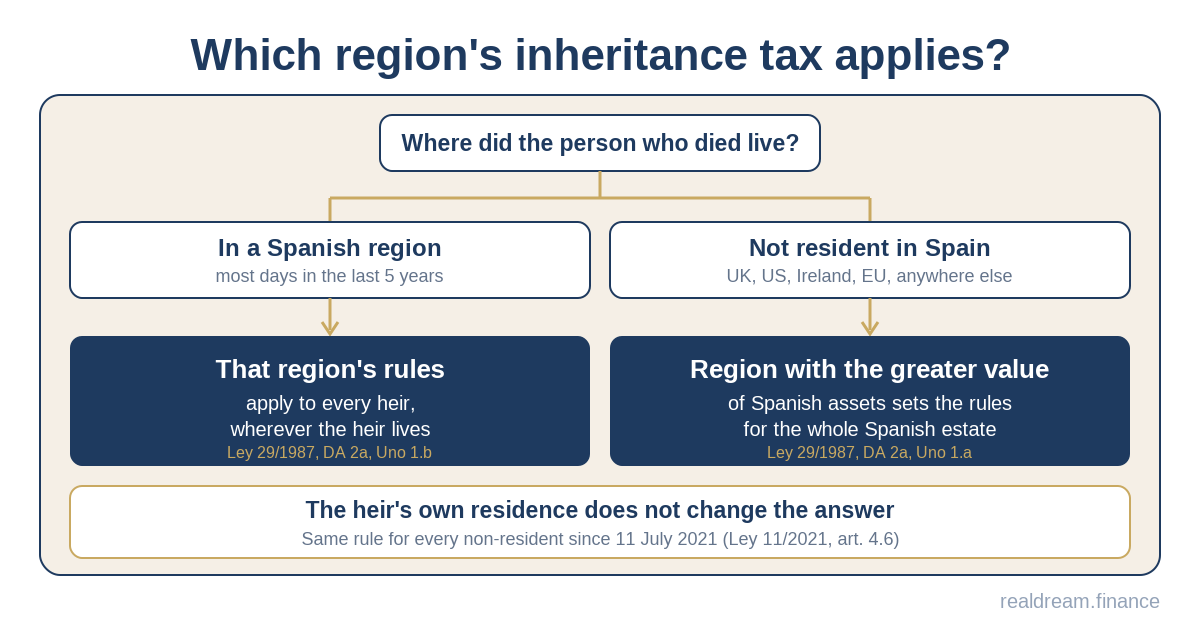
When you inherit Spanish property as a non-resident, one region's inheritance tax rules apply, and the law assigns it: if the person who died was not resident in Spain, the region holding the greater value of the Spanish estate; if they were resident in a region, that region. Since 11 July 2021 (Ley 11/2021, art. 4.6) this is the same for heirs in the UK, the US, Ireland or the EU. You file the Modelo 650 with the Agencia Tributaria within six months of the death.
Spanish inheritance and gift tax (Impuesto sobre Sucesiones y Donaciones, ISD) is a State tax whose reductions, rates and deductions each region can rewrite, so the same estate can produce very different bills depending on which region’s rules are applied. For a non-resident heir, that region is not picked by the heir’s passport, home country or preference. The law assigns it, based on where the person who died lived and where the Spanish assets are. This guide sets out the rule, the legal text behind it, the filing mechanics and the limits on recovering tax paid under the wrong rules.
Which region’s rules apply when you inherit Spanish property as a non-resident?
One region’s rules apply to the whole Spanish estate, and the law picks that region according to where the person who died lived. The rule sits in the second additional provision of Ley 29/1987 (the Inheritance and Gift Tax Act), paragraph Uno 1, in the wording given by article 4.6 of Ley 11/2021. It does not look at where the heir lives.
| Situation | Region whose rules apply | Text |
|---|---|---|
| Person who died was not resident in Spain | The region holding the greater value of the estate’s Spanish assets, applied to the whole estate | DA 2ª, Uno 1.a |
| Person who died was resident in a Spanish region | That region, for heirs who live abroad | DA 2ª, Uno 1.b |
| Not resident, and no Spanish assets | Each heir’s own Spanish region of residence (relevant only to heirs living in Spain) | DA 2ª, Uno 1.a, last sentence |
| Lifetime gift of Spanish real estate (not an inheritance) | The region where the property is | DA 2ª, Uno 1.c |
The last row is the one most often mixed up with inheritances. The test “the region where the property is” belongs to gifts of real estate. For inheritances the test is where the person who died lived, or where the greater value of the Spanish estate sits.
The text names one region per case and offers no menu of options. It says the heirs “tendrán derecho a la aplicación de la normativa propia” of that region, which grants the regional rulebook. It does not offer a choice between State and regional rules, or between two regions. Guides that describe a free choice are not reading the consolidated BOE text.
Does your nationality or your country of residence matter?
Since 11 July 2021, the heir’s nationality and country of residence do not matter: the same rule applies to every non-resident heir. A UK, Irish, US, Swiss or German heir receives the same answer, because the text says “no residentes” without distinguishing between the European Union, the European Economic Area (EEA) and other countries.
That was not always so. The rule changed in three steps:
| Date | What changed | Source |
|---|---|---|
| 1 January 2015 | Regional rules reach non-residents, but only where the person who died or the heir was resident in another EU or EEA state, after the Court of Justice judgment of 3 September 2014 (case C-127/12) | Ley 26/2014, DF 3 |
| 19 February 2018 | The Supreme Court (judgment 242/2018) applies the free movement of capital to residents of non-EU countries | STS 242/2018, cited in the preamble of Ley 11/2021 |
| 11 July 2021 | The statute extends the rule to all non-residents, EU or not | Ley 11/2021, art. 4.6 |
Brexit therefore changes nothing under today’s text. A UK heir sat in the EU/EEA group until the end of the transition period on 31 December 2020, and the 2021 wording removed the dividing line altogether. The same applies to a US or Canadian heir.
How do you find the region in three steps?
Three questions identify the region: where the person who died lived, where the Spanish assets are, and what each is worth on the day of death.
- Where did the person who died live? If they were resident in Spain, their region is the one where they spent the most days in the five years ending the day before death (DA 2ª, Uno 2). Their region applies to you as a non-resident heir (Uno 1.b). Stop here.
- If they were not resident in Spain, list every Spanish asset with its region and its value on the date of death. The tax falls due on that day (article 24.1 of Ley 29/1987).
- Compare the regions. The region holding the greater value of the Spanish estate sets the rules for all of it.
Take a non-resident who dies owning a flat in Alicante (€210,000) and a flat in Málaga (€150,000). The Valencian Community holds the greater value, so its rules apply to both flats and to every heir, wherever the heir lives. The Málaga flat is taxed under Valencian rules, not Andalusian ones.
The text says “mayor valor de los bienes y derechos del caudal relicto situados en España” and does not spell out whether to compare single assets or totals per region. Comparing totals per region is the natural reading, and it is the point to confirm with the Agencia Tributaria or an adviser when an estate is split across regions with similar values. For property, the tax’s own base is the Catastro reference value, or the declared value if that is higher (article 9.3 of Ley 29/1987, as amended by Ley 11/2021).
What does the region actually change?
The region can change four parts of the calculation, which is why identifying it matters. Article 48 of Ley 22/2009, which regulates the regional financing system, lists what the regions may regulate.
| Element | What a region may do | State default |
|---|---|---|
| Reductions of the taxable base | Create its own or improve the State’s | Reductions in article 20 of Ley 29/1987 |
| Tariff | Set its own scale | 7.65% to 34% (article 21) |
| Multipliers by pre-existing wealth | Set its own | 1.0000 to 2.4000 by kinship group and wealth (article 22) |
| Deductions and bonuses on the tax due | Add its own, applied after the State’s | State deductions and bonuses apply first |
No regional reduction or bonus figure appears in this guide. Each one comes from that region’s own legislation, which changes often, and the kinship group of the heir matters. Read the current text of your region, or have it read for you, before estimating a bill. The rules above cover the “common regime” regions; the Basque Country and Navarre tax inheritances under their own foral regimes, which this guide does not cover.
How and when does a non-resident heir file the Modelo 650?
A non-resident heir files the Modelo 650 with the Agencia Tributaria (AEAT) within six months of the death, and pays at the time of filing. The tax is ceded to the regions only for taxpayers resident in Spain (article 32.2 of Ley 22/2009), so a non-resident files with the State tax agency, applying the rulebook of the region the law assigned. Paragraph Dos of the second additional provision requires a self-assessment filed together with the payment.
| Step | What the AEAT sets out |
|---|---|
| Deadline | Six months from the day of death |
| Extension | Six more months, if requested within the first five months |
| Interest | Late-payment interest runs from the end of the six-month period |
| Extension request | Death certificate and an identity document of each heir (DNI, NIE or passport) |
| Representative | In the extension form, a representative must reside in Spain, and so must the notification address |
The extension does not stop interest: it postpones the filing, and the AEAT states that interest is due on the extended period. A request filed in month six is too late.
Can you claim back tax paid under the wrong region or the old rules?
Yes in principle, by asking the AEAT to rectify the self-assessment (article 120.3 of Ley 58/2003, the General Tax Act), but the right to a refund expires four years after the clock starts (article 66.c). For inheritances before 11 July 2021, most ordinary windows have already closed by 30 October 2026.
The four-year count starts the day after the filing deadline if you paid within it, or the day after payment if you paid later (article 67.1.c). Applying that rule:
| Situation | When the four years start | Open on 30 October 2026? |
|---|---|---|
| Death before 11 July 2021, paid within the deadline | At the latest 11 July 2022 (death on 10 July 2021, six-month deadline plus six-month extension) | Closed by mid-July 2026 |
| Paid after the deadline | The day after payment | Open if you paid after about 30 October 2022 |
| Death on or after 11 July 2021, wrong region applied | The day after the filing deadline | Open if that deadline ended after about 30 October 2022 |
| A claim or appeal already filed | The clock restarts after the claim (article 68.3 and 68.5) | Depends on the claim’s date and outcome |
These dates are arithmetic from the statute, not a ruling, and the AEAT may count the extension differently. For deaths before 11 July 2021, the legal basis for a non-EU heir is the Supreme Court doctrine of judgment 242/2018, not the statute, which only started on that date. If your window may still be open, the next step is a review of the self-assessment you filed; the non-resident tax service checks the region and the filing against the actual estate.
What do UK heirs need to know about double taxation?
A UK heir should expect Spanish tax on Spanish assets and then check whether the UK also taxes the same estate. The gov.uk table of inheritance tax treaties does not list Spain, so no treaty relief applies. UK law gives unilateral relief instead, under section 159 of the Inheritance Tax Act 1984: a credit against UK inheritance tax for the foreign tax charged on the same property. Where the property is situated only abroad, the credit equals the foreign tax; where it is in both countries, the credit is the smaller of the UK tax and the foreign tax, under a formula.
Whether UK inheritance tax applies depends on the status of the person who died, not on the heir, so it is a question for a UK adviser. Keep the Modelo 650, the payment receipt and the valuation: they are the evidence for any credit.
Sources
- BOE — Ley 29/1987, del Impuesto sobre Sucesiones y Donaciones (disposición adicional segunda, Uno and Dos; arts. 9, 20 to 22 and 24)
- BOE — Ley 11/2021, de medidas de prevención y lucha contra el fraude fiscal (art. 4.6 and preamble)
- BOE — Ley 26/2014, de 27 de noviembre (disposición final 3: wording of the second additional provision from 1 January 2015)
- BOE — Ley 22/2009, financiación de las Comunidades Autónomas (arts. 32 and 48: connecting points and regional powers over the inheritance tax)
- BOE — Ley 58/2003, General Tributaria (arts. 66, 67, 68 and 120: four-year limitation and rectification of self-assessments)
- Agencia Tributaria — Modelo 650 (non-residents): how to complete the application to extend the filing deadline
- Agencia Tributaria — Inheritance and gift tax for non-residents (Modelos 650, 651 and 655)
- legislation.gov.uk — Inheritance Tax Act 1984, section 159 (unilateral relief)
- GOV.UK — Inheritance Tax: double taxation relief (treaty table and unilateral relief)
Frequently asked questions
Can I choose between State rules and my region's rules?
The second additional provision of Ley 29/1987 names one region per case and offers no choice of region. It grants the heirs that region's own rules. It is silent on opting for the State rules instead, so confirm that point with the Agencia Tributaria before filing on any other basis.
Does it matter that I live in the UK, the US or Ireland?
No. Since 11 July 2021, article 4.6 of Ley 11/2021 gives every non-resident heir the same rule, whether they live in the EU, the EEA or a third country. The region depends on where the person who died lived and where the Spanish assets are, not on where the heir lives or holds a passport.
What if the person who died lived in Spain?
Their region of residence applies to you, even if you live abroad. That region is the one where they spent the most days in the five years ending the day before death. As a non-resident heir you file the Modelo 650 with the Agencia Tributaria, applying that region's rules.
How long do I have to file the Modelo 650?
Six months from the day of death. You can extend it by six months if you request the extension within the first five months. Interest runs on the extended period. The request needs the death certificate and an identity document of each heir.
Can I claim back inheritance tax paid before 2021?
Possibly, by asking for rectification of the self-assessment, but refund rights expire four years after the clock starts, usually the day after the filing deadline. For most deaths before 11 July 2021 that window has closed, unless a claim, an appeal or a late payment keeps it open. Check your own dates.
Roberta
Credit intermediary registered with the Banco de España (ICI)
Want us to take care of it?
We check which region's rules apply to your estate and the filing deadlines, so the Modelo 650 is prepared on the right rulebook.